
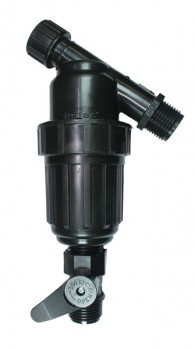
Description
Rain Hose End Fitting: Barb, Flange and Seal
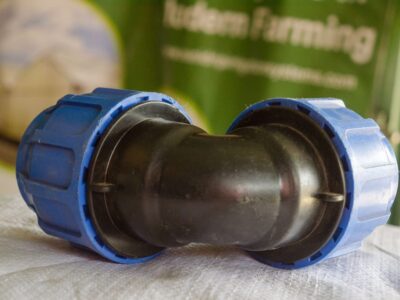
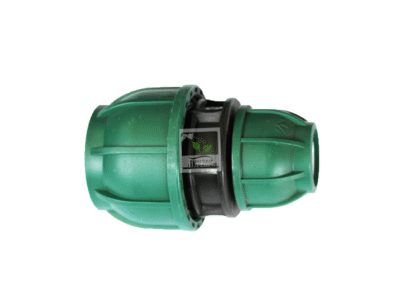
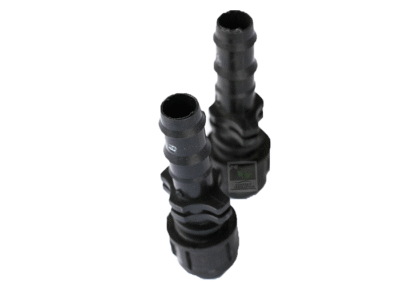
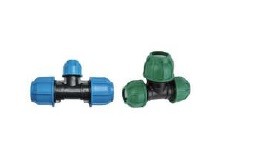
Rain hose end fittings close off the cut end of a rain hose line. They also let you tie that end into a valve, a tap, or a mainline pipe. In practice, every rain hose run needs one at the far end. Without it, water simply pours out of the open pipe and the bed never builds pressure. Eunidrip stocks end fittings to suit 32 mm, 40 mm and 50 mm rain hose for farms and greenhouses across Kenya. Each one is moulded as a single body, so there is no seam to split under pressure.
What Is a Rain Hose End Fitting?
Rain hose is a lightweight layflat pipe with holes punched along its length. You buy it on a roll, then cut it to the length of your bed. Cutting leaves an open end, and that open end has to be sealed. A rain hose end fitting is the part that seals it.
The fitting has three working features. First, a barbed tail that pushes inside the hose. Second, a flat flange head that butts against the hose mouth. Third, a rubber sealing ring that sits between the two and takes up any gap. Together they hold the joint shut without glue, thread tape, or special tools.
Because the barb carries the load, line pressure works for you rather than against you. Open the valve and the water drives the hose tighter onto the ridges. Close it and the seal holds its shape, so the joint is dry the next morning.
How the Barb, the Flange and the Seal Work Together
Each part solves a different failure. Remove any one of them and the joint starts leaking.
The barbed tail grips the inside wall of the hose. Deep ridges bite into the pipe, and that stops the fitting being pushed out. The flange head does a different job. It spreads the load across the hose mouth, so the pipe is pinched evenly instead of being cut by a sharp edge.
Meanwhile, the rubber ring handles the uneven bore. Layflat hose is rarely perfectly round once it has been rolled and unrolled. A hard plastic alone would leak along the flat side of that oval. The seal compresses into the gap, and the leak stops. Replace the ring when it goes soft or cracked, not the whole fitting.
Rain Hose End Fitting Compared with Couplings and Plugs
Farmers often buy the wrong part because the names overlap. The table below separates the four fittings that close or join a rain hose line.
| Fitting | What it does | Where it sits |
| Rain hose end fitting | Seals the cut end of the hose | Far end of every run |
| Straight coupling | Joins two hose ends in line | Mid-run, where two rolls meet |
| Tail connector | Barb plus thread for a valve or tap | Start of the run, at the water source |
| Pipe end plug | Blocks a threaded port | Inside an adapter or a manifold |
Also worth noting: an end fitting is not a repair clamp. If the hose splits mid-run, cut out the damaged section and join the two good ends with a coupling. Our PE middle connectors cover that job, and pipe end plugs cover threaded ports.
Rain Hose End Sizes: 32 mm, 40 mm and 50 mm
Rain hose in Kenya is sold by nominal bore, and our rain hose comes in three sizes. An end fitting is moulded to one bore only. So a 40 mm barb will not seal a 32 mm hose, and a 32 mm barb rattles inside a 50 mm line.
Check the printing on your roll before you order. Then push the barb in by hand to confirm the fit. A correct size needs firm pressure and a straight push. However, if it slides home with no resistance at all, expect it to blow off the first time you open the valve.
Typically the end of the run is where pressure is weakest, since the water has travelled the full length. That makes the end joint the one most likely to fail. Use the largest bore your source can feed on long runs, and keep each end fitting tested.
When You Need a New Rain Hose End Fitting
Replace the fitting rather than fighting it whenever you see one of these four signs.
- A steady drip at the end of the line. The seal has taken a permanent set.
- The hose slides off after watering. The barb ridges are worn or the bore has grown oval.
- White cracks at the flange. Sun damage has made the plastic brittle.
- A flattened hose mouth after storage. No fitting will seal a crushed end. Trim it back first.
In addition, replace the ring whenever you move a line to a new bed. It costs less than the fitting, and a fresh seal is usually enough to bring an old body back into service.
How to Fit a Rain Hose End Fitting
- Cut square. Trim the hose end flat with a sharp knife so the bore stays round.
- Warm the hose. In cold weather, dip the end in warm water for a few seconds. A flexible pipe slides over the barb more easily.
- Seat the seal. Slide the rubber ring onto the barb before you push anything home.
- Push and turn. Drive the fitting in with a half-turn as you go, until the flange sits flush against the hose mouth.
- Test open. Run the line and watch the end joint before you walk away. Every joint should be dry.
- Anchor it. Peg or bury the last metre so the weight of a full hose cannot lever the fitting out.
Next, keep one spare fitting and two spare seals for every ten beds. A failed end joint stops a whole line, and the fix takes minutes if you have the part on the farm.
End Fittings for Rain Hose and Layflat Pipe
The same barb, flange and seal pattern works on other layflat pipe. It suits PVC layflat hose as well as punched rain hose, provided the bore matches. For a threaded water source, pair the end fitting with a ball valve or a male adapter. Our HDPE adapters cover compression joints, and reducer sockets handle a change of bore.
Both systems draw from the same pipe work upstream. The irrigation pipes we stock feed either layout. Meanwhile, the Food and Agriculture Organization irrigation manual explains how to size a distribution line before you buy any fittings at all.
Quality Features of the End Fittings We Sell
Every end fitting we list is moulded as one piece, with no weld line across the barb. That matters because a weld line is where a fitting splits first. Sun and heat make poor compound go brittle, and a brittle fitting cracks the season after you install it.
In addition, the sealing rings are supplied to size rather than cut from sheet. A ring cut from sheet has an uneven wall, and an uneven wall leaks. Therefore each batch is sampled against a working line before it reaches the shelf.
Rain Hose Ends — Frequently Asked Questions
What size rain hose end fitting do I need?
Match the barb to the bore printed on your hose roll. That is 32 mm, 40 mm or 50 mm. Never size down and hope the seal will stretch.
Why does my rain hose end keep blowing off?
Usually the hose mouth is worn oval, or the barb is one size too small. Trim an inch off the end and refit before you blame the fitting.
Do I need a clamp on the joint?
No. The barb holds by friction and by line pressure. Instead, use a clamp only where a hose has been crushed flat in storage.
Can I use an end fitting to shorten a line?
Yes. Cut the hose to your bed length, then cap the new end. This is the normal way to fit a shorter run in a greenhouse.
How many end fittings should I buy per acre?
Count your runs, then add one spare for every five. Ends fail more often than couplings, since they sit at the weakest point of the line.
Will the seal last in Kenyan sun?
The ring is best shaded. Bury or mulch the end joint where you can, since shade extends the life of every rubber seal.
Where to Buy Rain Hose End Fittings in Kenya
Eunidrip Irrigation Systems supplies end fittings, hose, valves and full drip kits from one place. So your sizes match across the whole layout. We deliver countrywide, and our team can quote a fitting count from your bed lengths before you order.
Call or WhatsApp 0724 775 516 with your hose size and the number of runs. Alternatively, use our contact page to send a layout. Tell us the bore, the bed lengths, and where your water source sits. We will quote the rest.