

A passion fruit irrigation system has one job that separates it from a vegetable drip block. It must follow a trellis row and still deliver the same volume to the first vine and the last. Vines crop for years, they flower in flushes, and their feeding roots sit in the top 30 cm of soil. Because of that, the layout is set by the trellis and the pipe is sized by flow, not by the size of the farm. This guide works through both, then prices the parts.
Passion Fruit Irrigation System Design: What the Vine Asks For
A passion vine is planted once and picked for several seasons. Its water demand therefore changes with age, and the system has to be able to grow with it.
Roots of a young vine work within about a metre of the stem. A mature vine reaches further, yet most feeding roots stay in the top 30 cm. That shallow zone dries fast, so a small dose given often suits the crop better than a heavy soak every fortnight.
In practice, the trellis fixes the geometry. Rows sit 2.5 to 3 m apart, vines 2 to 3 m apart along the row, and the lateral has a fixed path to follow.
A passion fruit irrigation system built for a mature vine wastes water in the first year. Therefore the emitter count is planned in stages, and the lateral goes down once.
For the agronomy behind those spacings, the passion fruit farming in Kenya guide covers varieties, altitude and planting holes. This page stays on the water side of the fence.
Layout: Rows, Laterals and Blocks
Draw the block before you buy a single roll. That drawing decides how many valves you need and where the pressure will sag.
Total row length is the number that scales everything else. Divide the planted area by the row spacing, and the answer is the length of lateral you have to water.
On one acre, 4,047 m² divided by 2.5 m of row spacing gives about 1,619 m of trellis row. At 2.5 m between vines, the same acre carries roughly 648 vines.
| Layout decision | Typical figure | What it controls |
|---|---|---|
| Row spacing | 2.5 to 3.0 m | Total lateral length per acre |
| Vine spacing | 2 to 3 m | Emitters per 100 m of row |
| Lateral offset from stem | 15 to 30 cm | Where the wetting pattern lands |
| Trellis height | 1.8 to 2.0 m | Clearance for pruning and picking |
| Block size | 0.25 to 1 acre | Length of one irrigation run |
| One valve per block | Head of each block | Isolation during a repair |
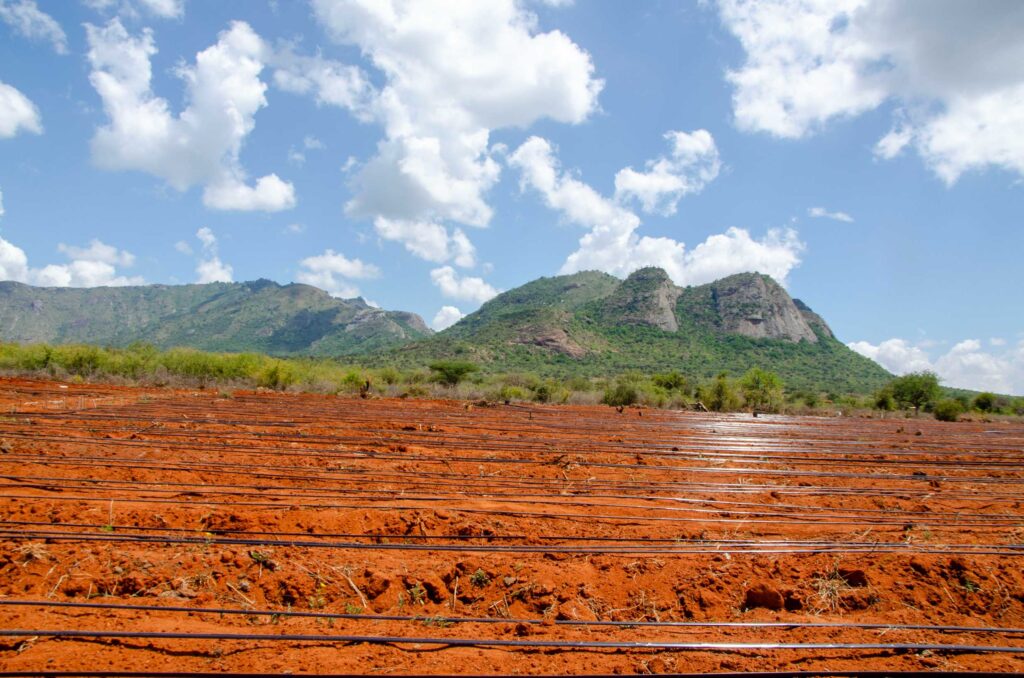
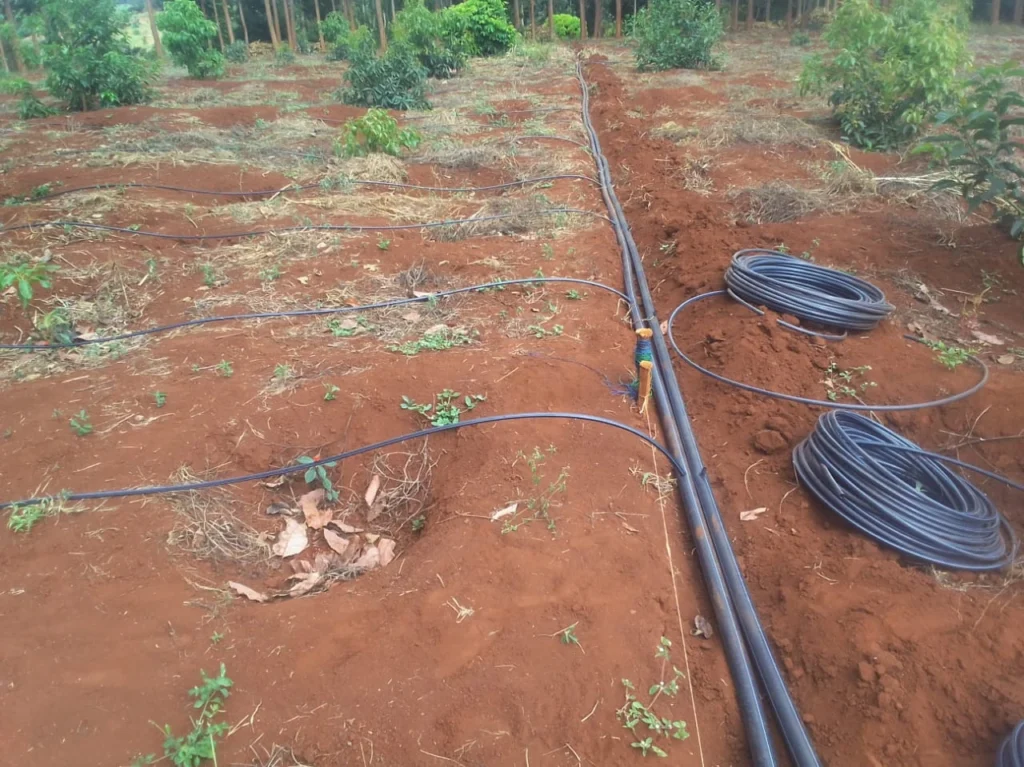
Each lateral runs parallel to its own trellis row, set back 15 to 30 cm from the stems. Consequently the water lands on the root mass and the alley between rows stays dry enough to walk on.
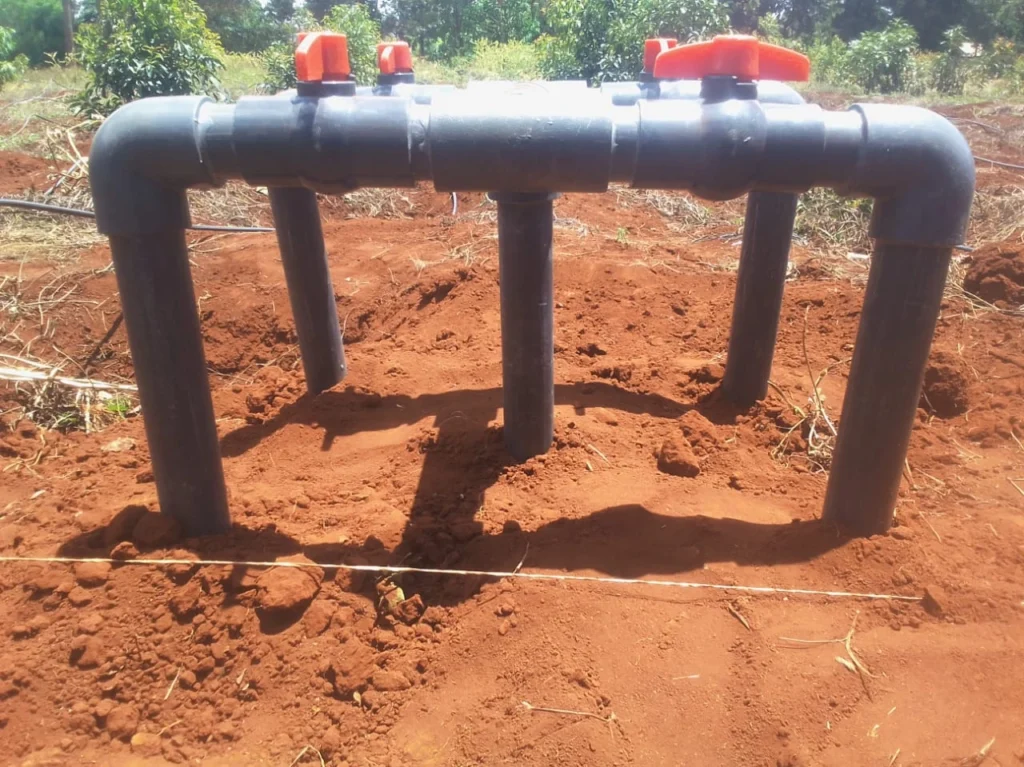
A block is the area one valve can water at the design flow. It is also the area you can shut off when a line is cut. Therefore blocks are kept small on a farm that harvests every week.
A passion fruit irrigation system with two or four blocks lets a repair happen while the rest of the farm keeps drinking. Meanwhile, the block valve doubles as the flow control at the head of each area.
How Many Emitters Each Vine Needs
One emitter is enough at planting. A mature vine on sandy soil wants two, and a high-yielding block may run four.
| Vine age | Emitters | Rating each | Water per vine per hour |
|---|---|---|---|
| At planting | 1 | 2 litres/hour | 2 litres/hour |
| First six to twelve months | 2 | 2 litres/hour | 4 litres/hour |
| From the second year | 2 | 4 litres/hour | 8 litres/hour |
| Heavy-cropping block | 4 | 2 litres/hour | 8 litres/hour |
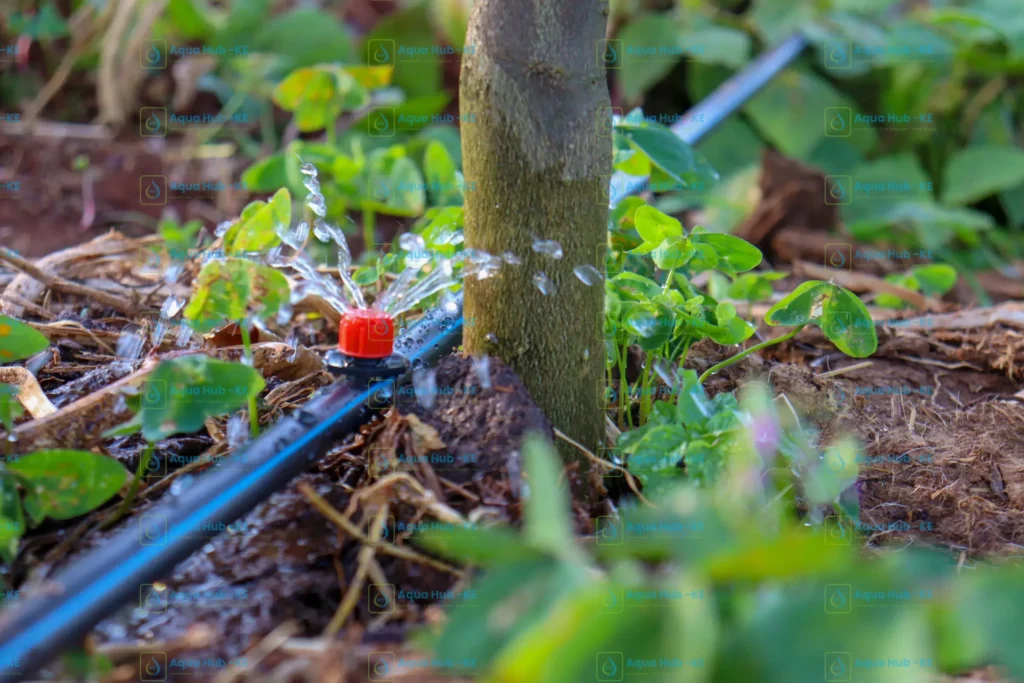
Two emitters set on either side of the stem spread water across the root mass instead of one wet spot. Similarly, four emitters on a heavy cropping block widen the wetted volume without raising the flow per emitter.
A passion fruit irrigation system planned for one emitter needs a check before a second line goes down. Two extra emitters per vine double the block flow, and the pipe or the run time has to absorb it.
Use plain button drippers on level ground, and switch to pressure-compensating button drippers where a lateral runs downhill or past 100 m. The compensating type holds its discharge as the inlet pressure falls, so the last vine is not left short.
Passion Fruit Irrigation System Pipe Sizes: Main, Sub-Main and Lateral
Size pipe by flow, not by acreage. A 32 mm main that works on a level acre will starve the far row of a block that climbs a slope.
Water wants to travel at about 1.5 m/s or less. Above that speed, friction eats pressure and the pump works harder than it should.
| Nominal size | Bore | Flow at 1.5 m/s |
|---|---|---|
| 16 mm | 13.6 mm | 800 L/hr |
| 20 mm | 17.6 mm | 1,300 L/hr |
| 25 mm | 22 mm | 2,000 L/hr |
| 32 mm | 28 mm | 3,300 L/hr |
| 40 mm | 36 mm | 5,500 L/hr |
| 50 mm | 45 mm | 8,500 L/hr |
| 63 mm | 57 mm | 13,500 L/hr |
The lateral is the 16 mm line that carries the emitters along the row. Forty vines on a 100 m row pull 80 L/hr at 2 L/hr each. At 8 L/hr per vine, the same row pulls 320 L/hr, which is still well inside the 800 L/hr that 16 mm pipe will take.
Specifically, the table assumes a bore close to the nominal size and clean water. A heavily scaled line carries less, so leave headroom on any run longer than 150 m.
Then check the block. One acre at maturity pulls 648 vines at 8 L/hr, or about 5,184 L/hr. That figure needs a 50 mm sub-main at the limit and a 63 mm main with room to spare. At establishment the same block pulls 1,296 L/hr, so a 25 mm line carries it.
Passion Fruit Irrigation System Flow Rate: Pump, Filter and Run Time
Three figures settle the pump: the block flow, the filter loss, and the hours you can spare in a day.
Add about 10% to the block flow for filtration and pipe losses. A mature acre needs 5,184 L/hr at the emitters, so the pump should hold roughly 5,700 L/hr at the head.
Next, turn crop demand into hours. At 5 mm a day of water use, one acre needs 5 mm × 4,047 m² = 20.2 m³, or about 20,200 L a day.
Divide that by the block flow and the schedule falls out: 20,200 ÷ 5,184 = 3.9 hours a day for a mature block. A young block pulling 1,296 L/hr needs about 15.6 hours, which is why young orchards usually run as one block and mature ones split into two or four.
The 5 mm figure is a design assumption for hot, windy weather. Substitute a pan reading or a soil-moisture figure and the arithmetic still holds.
Run the system at night where the pump allows it. Lower evaporation during the run, cooler water in the lateral, and a block that finishes before the pickers arrive. Because a passion fruit irrigation system works at low pressure, the pump only has to lift water to the head of the block.
Filtration and Fertigation for a Vine Crop
Filtration protects the emitters, and on a warm farm it is the cheapest insurance in the system. A screen or disc filter rated for drip service sits between the pump and the mainline. Where the source is a dam or a river, a sand media filter does the coarse work ahead of it.
Choose between the two housing types on dirt load, not on price. Screen filters and disc filters handle different debris, and a filter that blocks weekly costs more in labour than it saves.
Fertigation is the second reason to run drip on this crop. A vine flowers in flushes, so small regular feeds keep the plant working between them.
Every part of a passion fruit irrigation system that carries fertiliser has to be flushed clean at the end of the run. Otherwise the residue sits in the lateral overnight and hardens on the emitter wall.
Dissolve the fertiliser completely before it enters the line. Inject during the middle of the run, and flush with clean water for at least ten minutes afterwards. That flush pushes the remaining solution past the emitters and clears the line before it sits overnight.
Keep calcium nitrate in a separate tank from phosphate and sulphate products. Mixed together, they form a precipitate that settles in the lateral and blocks the emitters it was meant to feed.
Dosing is arithmetic, not judgement. A soil test gives the rate per acre, and dividing that rate by 648 vines gives the grams per vine. For example, 2 kg an acre becomes about 3 g per vine.
Watering a Passion Fruit Irrigation System Through the Dry Season
A steady root zone keeps flowering and fruit set going. A root zone that swings between flood and drought does the opposite.
Split the daily requirement into two shorter runs in hot weather. Two runs of two hours beat one run of four, because the soil holds the water instead of shedding it.
Check moisture at 20 cm before each run, not at the surface. A dry crust over damp soil is normal after a windy day, and irrigating on the crust alone wastes water.
Mulch the strip along the row with dry grass, straw, compost or black plastic. Keep the material a hand’s width clear of the stem, so the collar stays dry and the vine does not rot.
In addition, a passion fruit irrigation system that runs at night loses less water to the air than one that runs at noon. The saving shows up in the run time, not in the meter.
Dry-season fruit earns more, because supply falls while demand holds. Consequently the system has to keep the vine growing through the dry months, not restart it when the rain returns.
Where the pump is small, water the blocks in rotation and lengthen each run. Conversely, a large pump can run every block at once and finish the farm in an afternoon.
Maintaining a Passion Fruit Irrigation System: Flush, Clean, Replace
Maintenance on a drip block is a short routine repeated often, not a long job done once a year.
- Read the pressure gauge at the head and at the far end of the longest lateral. A widening gap points to a blockage.
- Walk one block a week and look for wet patches at the fittings and dry patches between emitters.
- Clean the filter element when the pressure drop across it doubles, and keep a spare element on the shelf.
- Flush each lateral at the end cap once a month, and let the water run until it clears.
- Pull one emitter every few months and check its discharge against the rating on the packet.
- Next, replace split laterals and cracked connectors as you find them, not at the end of the season.
- Run a cleaning treatment through the lines when the flush water stops clearing, then flush again.
- Record the run time and the block order, so the next person can follow the same schedule.
Because a blocked emitter fails quietly, the pressure gauge is the most useful instrument on the farm. A vine that wilts next to a wet patch is the other early warning. Pressure is the first thing to read on a passion fruit irrigation system, and the last thing most growers check.
Common Design Mistakes on a Trellis Block
Most failures on this crop are decided at the drawing stage, long before a pipe is laid.
| Mistake | What it causes | Correction |
|---|---|---|
| Sizing pipe by acreage | Weak pressure at the end of the block | Size by flow at 1.5 m/s |
| No filter, or a blocked one | Emitters that stop one by one | Filter at the head, cleaned on pressure drop |
| One emitter on a mature vine | A narrow wet spot and a shallow root mass | Two or four emitters per vine |
| Emitter hard against the stem | Collar rot and uneven rooting | Set back 15 to 30 cm |
| Running one long block all day | Deep percolation and wasted water | Smaller blocks, shorter runs |
| Fertiliser injected without a flush | Precipitate and blocked emitters | Flush ten minutes after every injection |
Each of these shows up as uneven growth, not as a broken part. Therefore the fix starts with the drawing and the gauge, not with the shovel.
What a Passion Fruit Irrigation System Costs in Kenya
The parts are priced per piece, so a bill of quantities can be built from the row length.
| Item | Shop price | Sold as |
|---|---|---|
| Pressure-compensating button dripper | from KSh 10 | Piece, 2 to 16 L/hr |
| Adjustable button dripper | from KSh 10 | Piece |
| Drip starter connector, 16 mm | KSh 15 | Piece |
| Drip valve, 16 mm | KSh 60 | Piece |
| Screen filter | from KSh 900 | ¾ to 2 inch |
| Irrigation water filter | from KSh 1,400 | ¾ to 2 inch |
| 16 mm HDPE pipe | from KSh 1,800 | 100 m roll |
| Drip tape | from KSh 8,000 | 1,000 to 2,000 m roll |
Take a 100 m row at 2.5 m vine spacing. It carries 40 vines, so it needs 40 drippers, 40 connectors and one valve, which comes to KSh 1,060 before the line itself.
Then add the line. A 100 m roll of 16 mm pipe lists from KSh 1,800, which puts a single row at about KSh 2,860. Scale that to one acre at 16 rows and the parts come to roughly KSh 46,000, before the mainline, filter, pump and tank.
Drip tape changes that arithmetic. The cheapest roll listed runs 1,000 to 2,000 m for KSh 8,000. Consequently tape works out between KSh 4 and KSh 8 a metre, against about KSh 18 for 16 mm pipe. On a long straight row tape is the cheaper line, and on ground that is cultivated or grazed pipe lasts longer.
A passion fruit irrigation system built from these parts costs less than a kit, because every metre of pipe is cut to the row instead of left on the roll.
Roll prices on drip tape and rain hose differ by wall thickness and length, so compare the cost per metre, not the price on the roll.
Choosing a Passion Fruit Irrigation System for a Kenyan Farm
Four choices decide most of the budget, and each one has a clear answer on a small farm.
- A gravity system where the tank sits 10 m above the field, and a pumped system where it does not.
- Drip tape on a long straight row, and 16 mm pipe where the line will be moved or driven over.
- Pressure-compensating drippers on sloping ground, and plain button drippers on a level block.
- One lateral per row at planting, and a second added when the canopy closes over the alley.
Where the farm supplies a town market and a processor, the block count matters more than the pipe size. Two small blocks let you harvest and irrigate on the same morning without stopping the water for the whole farm. In addition, the valve count decides how many fittings you move by hand each week.
A gravity layout has its own arithmetic, and the gravity drip irrigation design guide covers the head and tank height that make it work without a pump.
For a larger block, the orchard drip irrigation layout applies the same row-and-block logic to tree crops. The button drippers for avocado trees page shows the emitter spacing on a wider row.
Frequently Asked Questions About a Passion Fruit Irrigation System
How much water does a passion fruit vine need per day?
A mature vine at 8 L/hr for 3.9 hours takes about 31 L a day in hot weather. A young vine on a single 2 L/hr emitter takes far less, and the run time is set by the block flow, not by the vine.
How many drippers should each plant have?
One at planting, two from about six months, and up to four on a high-production block. Each emitter adds wetting area, and the total flow per vine stays within what a 16 mm lateral can carry.
Can I use drip tape instead of 16 mm pipe?
Yes, on a long straight row that stays in place. Tape is cheaper per metre, and pipe resists damage better where a line is moved or crossed by machinery.
What pipe size do I need for one acre?
A 25 mm sub-main carries the flow of a young block, and a mature block needs 50 to 63 mm. The lateral stays at 16 mm because it only carries one row.
How often should the system run in the dry season?
Once a day in most weather, split into two runs when the days are hot and windy. The run length comes from dividing daily demand by block flow, not from a fixed habit.
How much does a passion fruit irrigation system cost in Kenya?
The parts for one acre come to about KSh 46,000 with 16 mm pipe, or less with drip tape, before the mainline, filter, pump and tank. Cost of one acre drip irrigation breaks down the rest of the bill.
Order the Parts for a Passion Fruit Irrigation System
The bill of quantities follows the drawing, so a plan and a row count come before an order.
Eunidrip supplies the HDPE irrigation pipes, irrigation water filters, drip tape and automatic fertigation machine for a block of any size. Meanwhile, the irrigation equipment suppliers page covers the design service that goes with them.
A sieve analysis of the water source and a soil test come first, because both decide the filter and the fertigation programme. From there, the row length sets the lateral order and the vine count sets the dripper order.
Send the row count and the water source, and the layout can be drawn to the same arithmetic used here: flow at 1.5 m/s, 10% for filter losses, and a run time that fits the day. The work behind those figures is set out in the drip irrigation system design guide. The evapotranspiration method behind the 5 mm figure is documented in FAO Irrigation and Drainage Paper 56.