

Table of Contents
Insect nets for greenhouses are the cheapest pest control a grower can fit, and the easiest to fit badly. However, a roll of mesh does nothing until the count, the vent area and the fixing detail agree with one another. This guide works through those three decisions for Kenyan conditions, from the weave that stops a whitefly to the band that covers a 24 m wall.
Insect Nets for Greenhouses: What the Mesh Actually Stops
An insect net is a screen stretched across every opening in a structure. It holds pests outside while air moves through the weave. Because the barrier never switches off, protection runs through the night as well as the day.
A contact insecticide works after the pest has landed. A screen works before it arrives. That order of events matters in a warm house, where a whitefly population can build in days rather than weeks.
In practice, no screen seals a greenhouse. Workers, trays, tools and seedlings all pass through the door. Therefore a net is one layer in a pest programme, and it is the layer that carries the least risk.
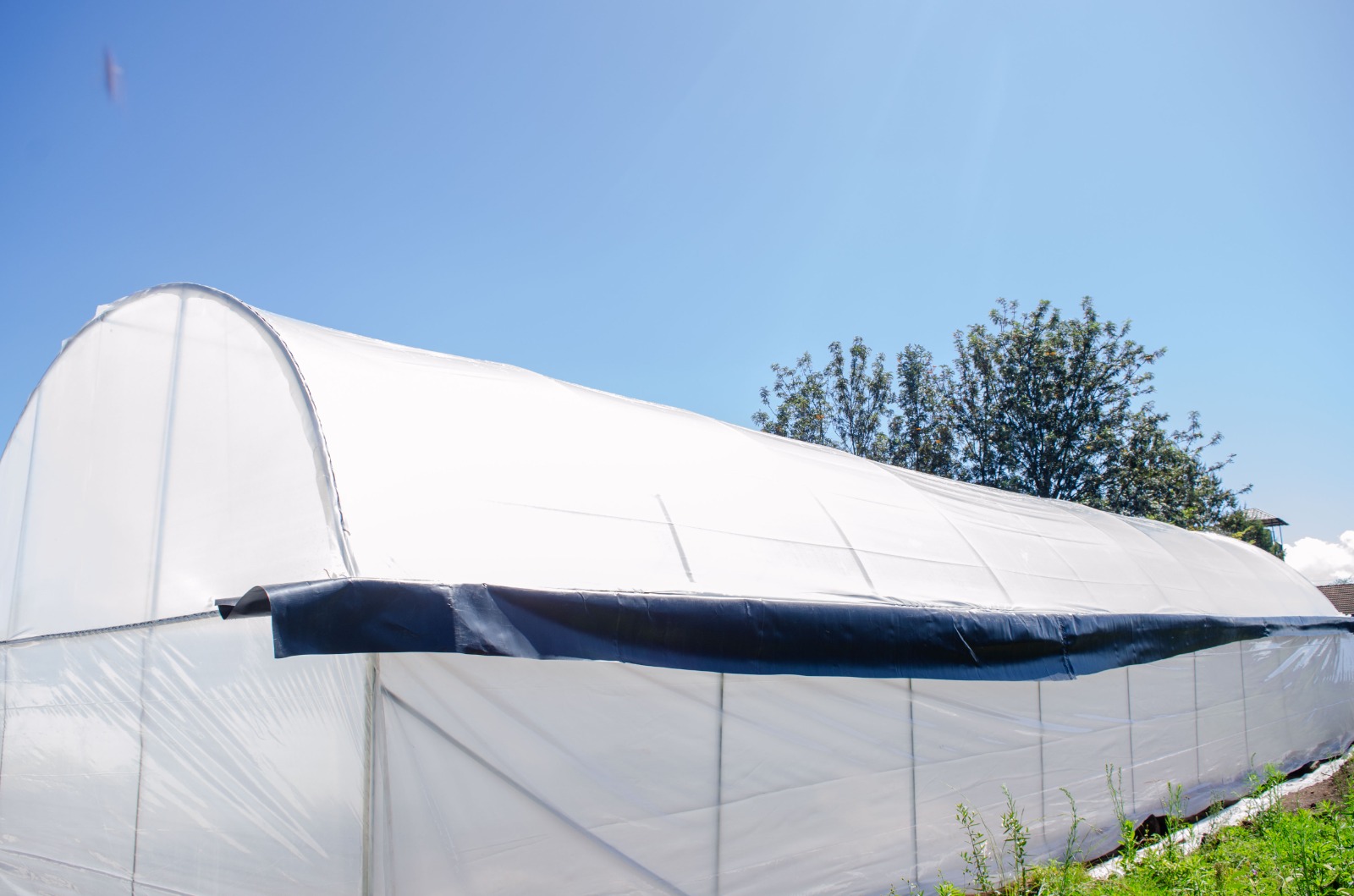
How Mesh Count Changes Airflow and Pest Exclusion
Mesh count describes how many openings sit across a fixed length of cloth. A higher count means a tighter weave.
Two counts describe the same idea from opposite ends. A 50-mesh screen packs more threads into the measurement, so the gaps between them are smaller. A 40-mesh screen uses fewer threads, and the gaps are wider.
The trade-off runs one way only. A tighter weave stops smaller insects and passes less air. A looser weave ventilates better and admits more.
For example, a 50-mesh screen across a long side opening can cut airflow enough to push internal temperature and humidity up. Meanwhile, a 40-mesh screen keeps air moving but leaves a gap for the smallest pests.
40 Mesh vs 50 Mesh for Whiteflies and Thrips
The two counts suit different problems. Whiteflies are small enough to slip through a wide weave, so a 50-mesh screen is the safer choice where whitefly pressure is heavy. Thrips are smaller still, and they can work through a 40-mesh screen during a strong infestation.
However, the finer screen asks more of the design. On a hot lowland site, 50-mesh over every opening can leave the house too still. The answer is more vent area, not a coarser mesh.
A 40-mesh screen still earns its place. It suits a crop where pest risk is moderate and the afternoon heat is the harder constraint.
| Specification | 40 mesh | 50 mesh |
|---|---|---|
| Weave density | Fine | Finer |
| Opening size | Wider | Narrower |
| Whitefly exclusion | Partial | Strong |
| Thrips exclusion | Limited | Better |
| Air movement | Better | Restricted |
| Vent area needed | Standard | Larger |
| Best use | Heat-limited sites | Pest-led sites |
Which Pests an Insect Net Keeps Out
Whiteflies sit at the top of the list on most Kenyan holdings. The adults fly, feed on sap and multiply quickly under cover. They also carry several plant viruses, so a small population is a larger problem than the count suggests.
Also on the list are thrips, aphids, leafminers, small moths and some beetles. Each one is a feeder, and several are vectors as well.
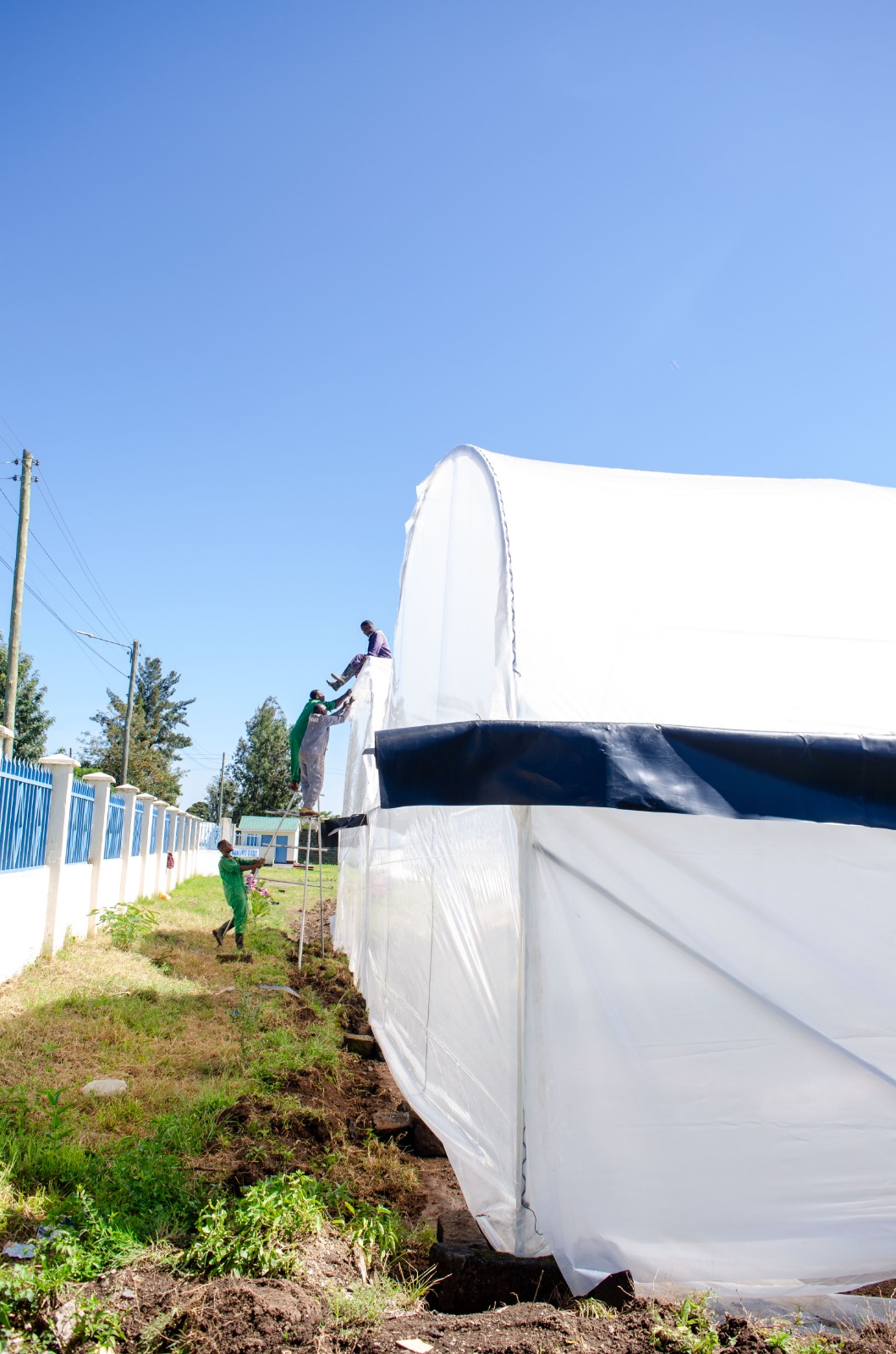
Because the screen holds the adults outside, it also interrupts the breeding cycle within the house. Fewer arrivals mean fewer eggs, and a scout has far less to find on a sticky trap. Therefore the value of insect nets for greenhouses lies in numbers, not in a perfect seal.
Sizing Insect Nets for Greenhouses: Vent Area and Airflow
Vent area is where most installations fail. The net is ordered to fit the frame, and nobody checks whether the frame has enough opening for the mesh chosen.
Start from the roll. A 3 m wide roll cuts into three strips of 1 m. Because each strip runs the full 50 m length, one roll yields 150 m of vent band.
Then measure the openings. On an 8 m by 24 m house, a 1 m band along each long wall needs 48 m of screen. Therefore one roll covers about three houses of that size, with 6 m left for repairs.
Also count the gable ends, the ridge vent and the door. Those openings add screen, and they are the ones forgotten at ordering time. That single figure is what an order for insect nets for greenhouses should be built on.
A finer weave needs a bigger opening. In practice that means a wider band, a longer wall or an extra roof vent, never a coarser net.
Installing Insect Nets for Greenhouses on Side and Roof Vents
Side vents and roof vents carry most of the airflow, so they also carry most of the pest risk. Both are screened the same way, and both are screened before the film is trimmed.
- Measure each opening across its full frame, not the clear gap.
- Cut the screen with 150 mm of allowance on every edge.
- Lay the screen flat and square before lifting it into place.
- Fix the top edge first, then pull the screen down under light tension.
- Lock the side edges into the channel and check for waves.
- Fit the roll-up bar or curtain gear where the vent opens.
- Walk the perimeter and close every gap wider than a fingertip.
The screen should be taut without being stretched. A stretched weave opens at the threads, and the hole grows with every season.
Installing Insect Nets for Greenhouses at Doors and Entry Chambers
The door is the weakest point in any screened house. A well-covered roof vent means nothing while the door stands open beside the crop.
A properly fitted door carries its own screen panel, and the panel closes before the frame does. That detail keeps the entrance working as a barrier rather than a hole.
For higher exclusion, some commercial houses use a double door or a small entry chamber. The worker crosses one door, stands in a short lobby, and closes that door before opening the second.
Because the lobby holds the air, insects that follow a person in are trapped in the gap instead of being released beside the crop.
Fixing Insect Nets for Greenhouses to the Frame
The screen is only as good as its fixing. Aluminium lock channel and wiggle wire are the usual pairing on a steel frame, and the same profile that holds the film can hold the net.
Supporting wires stop a wide panel from sagging between hoops. Furthermore, they carry the weight of a wet or dusty screen without loading the fabric.
Edges matter more than the middle. A 10 mm gap along one wall admits more insects than a pinhole in the centre of a panel.
The framing detail is covered in depth on the greenhouse film fixing system page, because net and film share the same channel.
Roll Widths, Roll Lengths and Cost Per Square Metre
The stocked roll is 3 m wide and 50 m long. That is 150 m² of screen in one piece, which suits a few vent bands and a stock of repair patches.
| Item | Measure | Price |
|---|---|---|
| Insect net roll | 3 m × 50 m (150 m²) | KSh 12,000 |
| Regular price of the same roll | 3 m × 50 m (150 m²) | KSh 13,500 |
| Roll price per square metre | 1 m² | KSh 80 |
| Screen sold by the metre | 1 m² | KSh 100 to 120 |
The roll is listed at KSh 12,000 against a regular KSh 13,500. Spread across 150 m², the sale price works out at KSh 80 per square metre. Screen sold by the metre is quoted higher, so a full roll is the cheaper way to buy.
Also check the width before ordering. A 3 m roll is generous for a 1 m band, and the offcut is worth keeping for repairs.
Maintenance and Service Life of Insect Nets for Greenhouses
Dust is the quiet failure. A screen loaded with soil and pollen blocks air as effectively as a sheet of film, and the house overheats before anyone notices.
Clean the screen at the start of each dry spell and again after harvest. A soft brush and clean water lift most of the load without abrading the weave. Cleaning is the cheapest way to keep insect nets for greenhouses at full airflow.
Inspect after every storm, because wind damage shows at the fixings first. Check the panel for tears, holes, loose edges and sagging sections, then look at the channel and the wire.
A UV-stabilised agricultural screen commonly gives 3 to 7 years in Kenyan conditions. The life depends on sun, wind, installation and cleaning, so two houses of the same age can differ by years.
Insect Nets for Greenhouses in an Integrated Pest Programme
A screen is most useful when it is not working alone. It lowers the number of pests that arrive, and the rest of the programme deals with the ones that get through.
Scout the crop weekly with sticky traps placed at crop height. Also keep the door routine tight, remove crop debris and control weeds around the house.
Where a pest does establish, biological control can hold it below the damage threshold. Specifically, natural enemies of whitefly and thrips work best in a house that is not being sprayed broadly.
Integrated pest management sets out the sequence of monitor, identify and act at a threshold. A net buys the time for that sequence to run, and the whitefly and thrips profiles show what each pest does to a crop.
Frequently Asked Questions About Insect Nets for Greenhouses
What mesh count should I buy for whiteflies?
Fifty mesh is the usual choice where whitefly is the main threat. Forty mesh suits a house where airflow matters more than excluding the smallest insects.
Do insect nets reduce airflow enough to overheat the house?
Yes, a fine screen cuts airflow, and the effect shows on a still afternoon. The compensation is more vent area, not a coarser weave.
How long does an insect net last in Kenya?
Three to seven years for a UV-stabilised screen. Strong sun, wind and poor fixing shorten that life.
Can I fit a net over an existing greenhouse?
Usually yes, if the frame carries a lock channel or a profile the net can share with the film. Without a channel, the edges need a batten and a mechanical fix.
How much net do I need for an 8 by 24 m greenhouse?
About 48 m of 1 m band for the two long sides, plus the gables and door. One 3 m by 50 m roll covers three houses of that size.
Does a net replace spraying?
No. It lowers the number of pests that arrive and slows the population build-up. Hygiene, scouting and targeted spraying still carry the rest.
Order Insect Nets for Greenhouses in Kenya
Send the house size, the mesh count and the openings that need covering. The team can then work out the roll length and the fixing detail together, and confirm the price for the grade you need.
The stocked roll is on the insect nets product page. For the covering around it, the 200-micron polythene sheet page sets out the film specification, and the vented and tunnel greenhouse designs comparison settles the shape of the house. A standard 8 by 24 m greenhouse is costed on its own page, and the metallic greenhouse frame suits a site that needs a longer service life. For bird pressure rather than insect pressure, the bird nets range covers a different mesh.