

Table of Contents
Eunidrip Irrigation Systems is one of the dam liner suppliers in Kenya, and we sell from a yard in Nakuru and through this shop. The product is easy to describe: a sheet of polyethylene, cut to the size of your dam and welded on site. What separates a careful supplier from a cheap one is rarely the sheet itself. It is the thickness advice, the welding crew, the delivery plan, and what happens after the first leak.
The five checks below work on any of the dam liner suppliers in Kenya, including us. Apply them to every quote you receive, and compare the answers rather than the price per square metre alone.
- Check 1 – the material and whether the resin is virgin
- Check 2 – thickness stated in microns
- Check 3 – the welding crew and the seam test
- Check 4 – the panel layout and the offcuts
- Check 5 – the warranty and the repair route
What Dam Liner Suppliers in Kenya Should Provide
A liner is bought once and buried for a decade, so the supplier’s job does not end at the roll. Five things should come with the sheet, and four of them are paper or people.
- A material data sheet naming the polymer and the thickness in microns
- An installation crew that welds on site, with the welding method named in the quote
- A panel layout drawing, so the sheet is cut to fit the dam rather than the roll
- A delivery plan that says who unloads the rolls and where they are stored
- A written warranty, plus a repair route for a puncture
Therefore ask for those five before you compare prices. A quote that cannot produce them is a quote for a sheet of plastic, not for a lined dam.
Dam Liner Thickness, Use and Price at a Glance
Our current discounted prices are below. They are priced per square metre, and they move with the shilling and with the roll, so treat them as a guide rather than a fixed quote.
| Thickness | Where it fits | Discounted price per m² |
|---|---|---|
| 0.5 mm (500 microns) | Garden ponds, fish ponds, fine soil | KSh 240 |
| 0.75 mm (750 microns) | Farm dams and water reservoirs | KSh 340 |
| 1.0 mm (1,000 microns) | Large reservoirs, stony ground | KSh 450 |
For the product options behind those figures, the shop’s dam liner prices in Kenya page goes further than this table does.
Check 1 – The Material, Not the Label
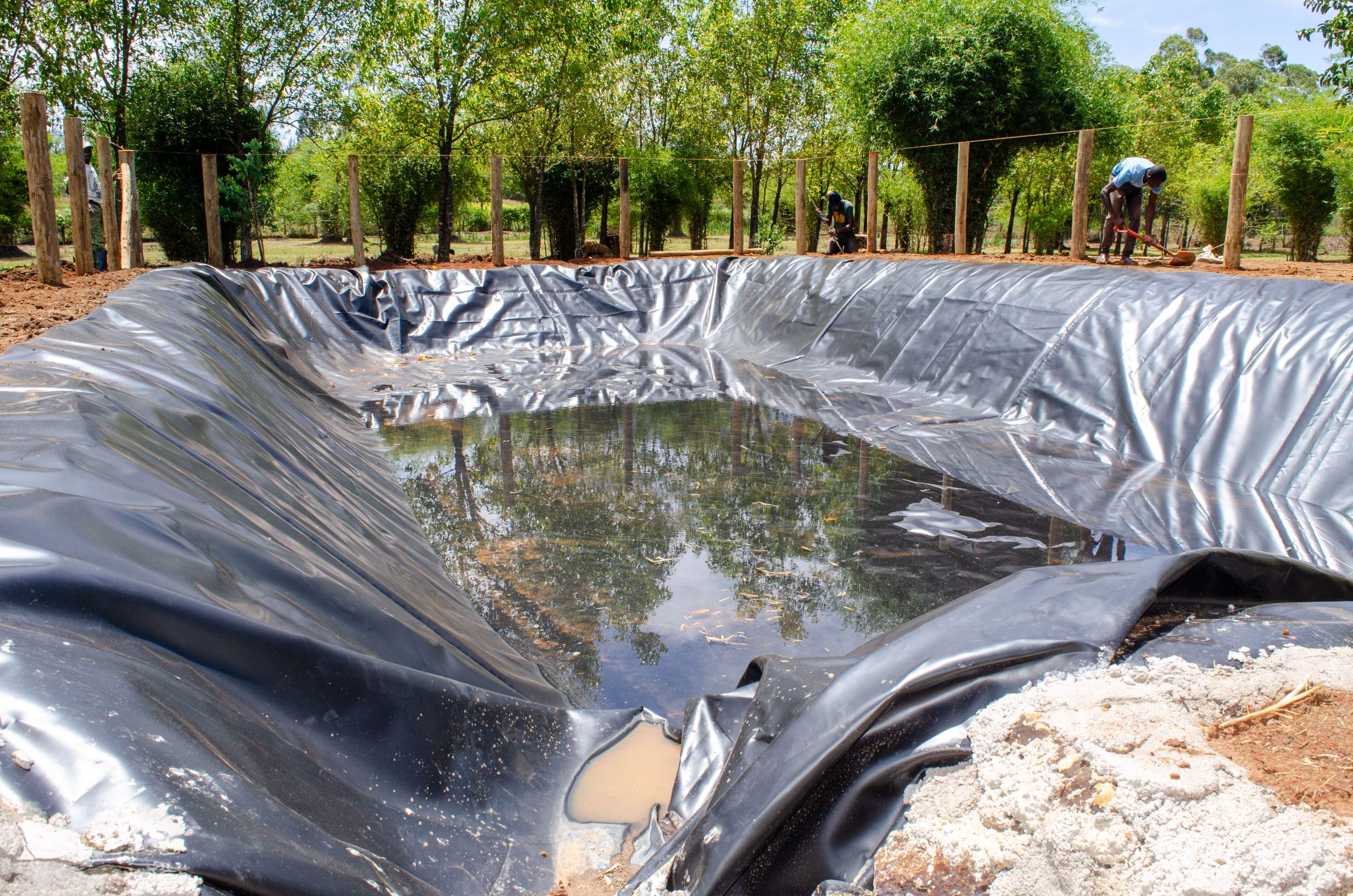
Across dam liner suppliers in Kenya, the same four materials keep appearing: HDPE, LDPE, PVC and RPE. HDPE is the stiff, strong sheet used for most farm dams. Similarly, LDPE is softer and easier to fold. PVC is flexible and easy to weld. RPE is a reinforced sheet used where the ground is rough.
The question that matters is not which material, but whether the resin is virgin or regrind. Regrind is recycled scrap, and it is cheaper. It also loses strength at the fold, which is where a liner tends to fail first. Therefore ask for the material data sheet, and check the resin description rather than the colour of the roll.
Check 2 – Thickness Measured in Microns
Dam liner suppliers in Kenya may quote thickness in millimetres, microns or mils, and one sheet can appear as 0.5 mm, 500 microns or 20 mil. Ask for microns in writing, then compare every quote on that single number.
Thicker is not automatically better. A 1.0 mm sheet laid on stony ground will puncture almost as fast as a 0.5 mm sheet, because the stone is the problem. Instead, the answer there is a geotextile underlay, and a good supplier will say so before selling you the heavier roll.
Then match the thickness to the site. Fine soil under a small pond suits 0.5 mm. A farm dam that must hold water through the dry season suits 0.75 mm. Rough ground or a large reservoir suits 1.0 mm, with underlay beneath it.
Check 3 – The Crew Behind Dam Liner Suppliers in Kenya
The crew is where dam liner suppliers in Kenya differ most, and it is the part a price list cannot show you. A liner is only as watertight as its seams. Ask how the panels will be joined: thermal welding with a wedge welder, or tape and adhesive. Our guide to thermal welding versus tape for HDPE liners compares the two methods.
Then ask two more questions. Will the crew test the seams on site, and will you receive the result? A supplier who welds without testing is asking you to trust a seam you will never see once the dam fills.
Ask about the anchor trench as well, because the liner has to be buried at the rim to stay in place. Our page on the dam liner anchor trench covers the depth and the backfill.
Check 4 – Delivery, Wastage and Offcuts
Few dam liner suppliers in Kenya explain the panel layout, and that silence costs money. Rolls come in fixed widths, so the way the panels are arranged decides how much sheet is wasted. For example, a careful layout can save a tenth of the material on a rectangular dam.
Therefore ask for the layout drawing before you approve the order, and ask what happens to the offcuts. Some suppliers charge for the full roll. Others charge only for the cut area. The difference appears on the invoice rather than in the quote.
Delivery is the second half of this check. Rolls are heavy, and a lorry that cannot reach the dam is a cost you pay twice. Confirm the access, the offloading and the storage before the sheet leaves the yard.
Check 5 – Warranty, Repairs and After-Sale
After-sale support is where dam liner suppliers in Kenya are hardest to compare, because every quote promises it and few put it on paper. Ask for three things: the warranty period, what voids it, and how long a repair takes.
Punctures happen. A thorn, a hoof or a careless spade will open a small hole, and a small hole will drain a dam. Therefore ask what the supplier sells for repairs. A roll of dam liner repair tape plus a patch of the same sheet will close most damage, if you keep both before you need them.
Then ask who does the repair when the damage is larger than a patch. A supplier with a welding crew can come back to site. A supplier who only sells rolls cannot.
Dam Liner Suppliers vs Dam Liner Prices
Those are two different searches, and it helps to keep them apart. Also, it keeps both pages honest, because a price that changes monthly should not sit inside an article about choosing a supplier. This page is about choosing the supplier and the installation. The price tables sit on their own pages, where they can be kept current without rewriting an article.
For the range and the per-metre figures, the shop lists dam liners for sale in Kenya. If you already know the dam’s dimensions, the dam liner sizing formula turns them into the square metres you need to order.
Then pick the sheet for the site. Our guide to the 0.75 mm HDPE dam liner explains the middle of the range, which is where most farm dams land.
For the engineering side, the FAO manual on small earth dams is a free reference on siting, design and construction.
Frequently Asked Questions About Dam Liner Suppliers in Kenya
How do I compare dam liner suppliers in Kenya? Send the same five questions to each one: material and resin, thickness in microns, welding method and seam test, panel layout, and the warranty. Then compare the written answers, not the price per square metre.
What thickness of dam liner do I need? Fine soil around a small pond suits 0.5 mm. A farm dam that must hold water through a dry season suits 0.75 mm. Stony ground or a large reservoir suits 1.0 mm, laid over a geotextile underlay.
Do suppliers install the liner, or do I fit it myself? Small ponds can be lined by hand. Anything larger needs a welding crew, because the seams decide whether the dam holds. Ask for the welding method and the seam test result in writing.
How much does a dam liner cost per square metre in Kenya? Our discounted prices run from KSh 240 per square metre at 0.5 mm to KSh 450 at 1.0 mm. Confirm the figure on the day you order, because it moves with the shilling and with the roll.
Can a torn liner be repaired? Yes, when the tear is small. Clean the sheet, dry it, and patch with repair tape and a piece of the same liner. A larger tear needs a welded patch from the installation crew.
Where are you located? Our yard is on George Morara Road in Nakuru. Buyers outside Nakuru order through the online shop, and we confirm the transport with you before dispatch.
How to Order From Dam Liner Suppliers in Kenya
Send us the dam’s length, width and depth, and the state of the ground. We will confirm the thickness, the roll size and the number of panels, then quote the sheet and the installation separately. Call +254 728 163329, or open the dam liner and geomembrane dam liner pages, which carry the current stock and prices.
If you are comparing dam liner suppliers in Kenya, ask each one the five questions above and keep the answers in one place. The cheapest sheet is rarely the cheapest dam.