

Components of an HDPE Connector
The components of an HDPE connector decide whether a joint holds pressure or weeps. Most farmers only ever see the finished fitting. That is a costly blind spot. A compression connector is five small parts, and each one has exactly one job. When you know the parts, three jobs get easier. First, you buy the right spare. Second, you can reject a weak fitting at the shop counter. Then you assemble a joint that survives the season. This guide names every component of an HDPE connector we stock. It also shows how the pieces work as a set.
The Five Components of an HDPE Connector, Part by Part
The exploded view below separates a compression connector into five pieces. The letters match the photo, so you can identify each part on site.
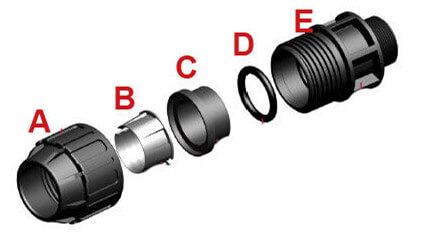
- A — Gland nut. The ribbed outer nut you tighten by hand. Its ribs give grip, and its internal thread pulls every other part forward. Because threaded glands crack at the root when over-tightened, this is the most common spare.
- B — Reinforcement ring. The stiff ring under the gland that spreads clamping force around the pipe. It keeps the pipe from creeping forward under pressure. This one photographs in a lighter tone than the black parts. However, confirm its material with us before you assume it is plastic.
- C — Grab ring. A black cup-shaped clipping ring with a biting edge. It digs into the pipe surface and stops the pipe pulling out. This matters where the line is dragged or the soil shifts.
- D — Sealing ring. A thin flat O-ring that sits against the pipe and does the water-tight work. Everything else holds the joint together. Therefore this small ring is the part that stops the leak.
- E — Threaded body. The fitting body with the external male thread. The pipe enters one end, and the threaded end screws into a valve, a tank adapter, or the next fitting. The body also carries the channel the sealing ring sits inside.
Two things usually cause a leak. Specifically, one is the sealing ring (D). The other is a cut end that was never reamed.
How the Components of an HDPE Connector Work Together
Tightening the gland nut drives the reinforcement ring forward. That ring presses the grab ring onto the pipe, and the grab ring bites. Meanwhile the sealing ring is squeezed into its channel, where it wraps the pipe. First the joint is gripped, then it is sealed. Therefore the assembly order matters. A sealing ring twisted before the nut goes on will fold, and a folded ring leaks.
Also, the pipe must be cut square and pushed fully home against the body shoulder. A pipe stopped short leaves the grab ring biting near its end, where it has less to hold. In addition, a rough or oval bore prevents the sealing ring from seating evenly. For that reason we size connectors to the pipe’s outside diameter, never to its inside diameter.
Which of the Components of an HDPE Connector Fails First
The gland nut fails first, and usually from over-tightening. Plastic threads strip long before a pipe bursts, so hand-tight plus a partial turn is enough. Next comes the sealing ring, which dries out and takes a set after years in full sun. Also, UV exposure embrittles any part left above ground. In addition, grit trapped against the grab ring stops it biting cleanly. That turns a good joint into a weeping one.
Because of that, buy a spare set of the components of an HDPE connector. A whole new fitting costs far more, and digging out a buried joint mid-season costs more still.
Components of an HDPE Connector vs Push-Fit and Electrofusion Fittings
A compression connector is not the only joint type. The table below compares the three methods farmers in Kenya actually buy.
| Method | Parts involved | Tools needed | Best for |
|---|---|---|---|
| Compression, like the components of an HDPE connector above | Five loose parts, all replaceable | None beyond a spanner on threaded ends | Small lines, repairs, and sites where fittings get reopened |
| Push-fit | Sealed unit, no loose gland | Pipe cutter and a depth gauge | Fast laterals and dripline work |
| Electrofusion | One fused sleeve, permanent | Fusion machine and power | Buried mains that should never be opened |
Choose compression when you want the joint to be reopenable. That is the honest trade. A fused joint is stronger. However, you cannot service the components of an HDPE connector once they are melted into one piece.
Specifications for HDPE Compression Parts
Our threaded compression connectors cover the common irrigation sizes. They run from small laterals up to the mainline. The HDPE compression coupling fitting holds the middle of that range. Likewise, the reduced HDPE coupling joins two different diameters in one body. Material is high-density polyethylene, the resin marked 2. It is described in this overview of HDPE. Therefore the plastic is chosen for stiffness and for UV-resistant carbon loading, rather than for clarity.
How to Reassemble a Compression Connector
Start by pulling the gland off and tipping the parts out in order. Next, slide the gland, then the reinforcement ring, then the grab ring onto the pipe. After that, check the sealing ring inside the body for a fold. Then push the pipe home against the shoulder, and run the gland forward by hand. Finally, tighten a partial turn with a spanner and stop. If the joint weeps after that, undo it and re-seat the sealing ring. Then tighten again, rather than forcing the nut harder.
Where to Buy HDPE Connector Parts in Kenya
We stock the components of an HDPE connector with every threaded compression fitting. Also, we ship countrywide. Check out Hdpe female Adapter and Threaded male adapter . For the wider catalogue, see our pipes category.
Call or WhatsApp 0728 163 329 with your pipe size. Also tell us the quantity you need, and we will confirm stock the same day.
Frequently Asked Questions About the Components of an HDPE Connector
How many parts are in a compression connector?
Five: the gland nut, reinforcement ring, grab ring, sealing ring, and threaded body. Some cheap connectors drop the reinforcement ring, and those joints creep under pressure.
What are the components of an HDPE connector made of?
The gland, grab ring, sealing ring, and body are moulded plastics, typically HDPE or copolymer. The reinforcement ring may be metal on heavier sizes, so check before you assume.
Can I replace just one part instead of the whole fitting?
Yes, and that is the main advantage of a compression body. Gland nuts and sealing rings are the two parts worth keeping as spares on the farm.
Which part actually stops the leak?
Only the sealing ring. The grab ring and the gland hold the joint together. However, water tightness comes from that one thin ring sitting flat on the pipe.
Do these components work on old, sun-cracked pipe?
Not reliably. A pipe whose surface is chalked or cracked will not seal against the ring. Cut back to sound pipe before you fit a new connector.
Are these the right parts for drip line installations?
For 16 mm and 20 mm tape and pipe, yes. Pair the compression body with a button dripper downstream. Then size the connector to the outside diameter of the line.