

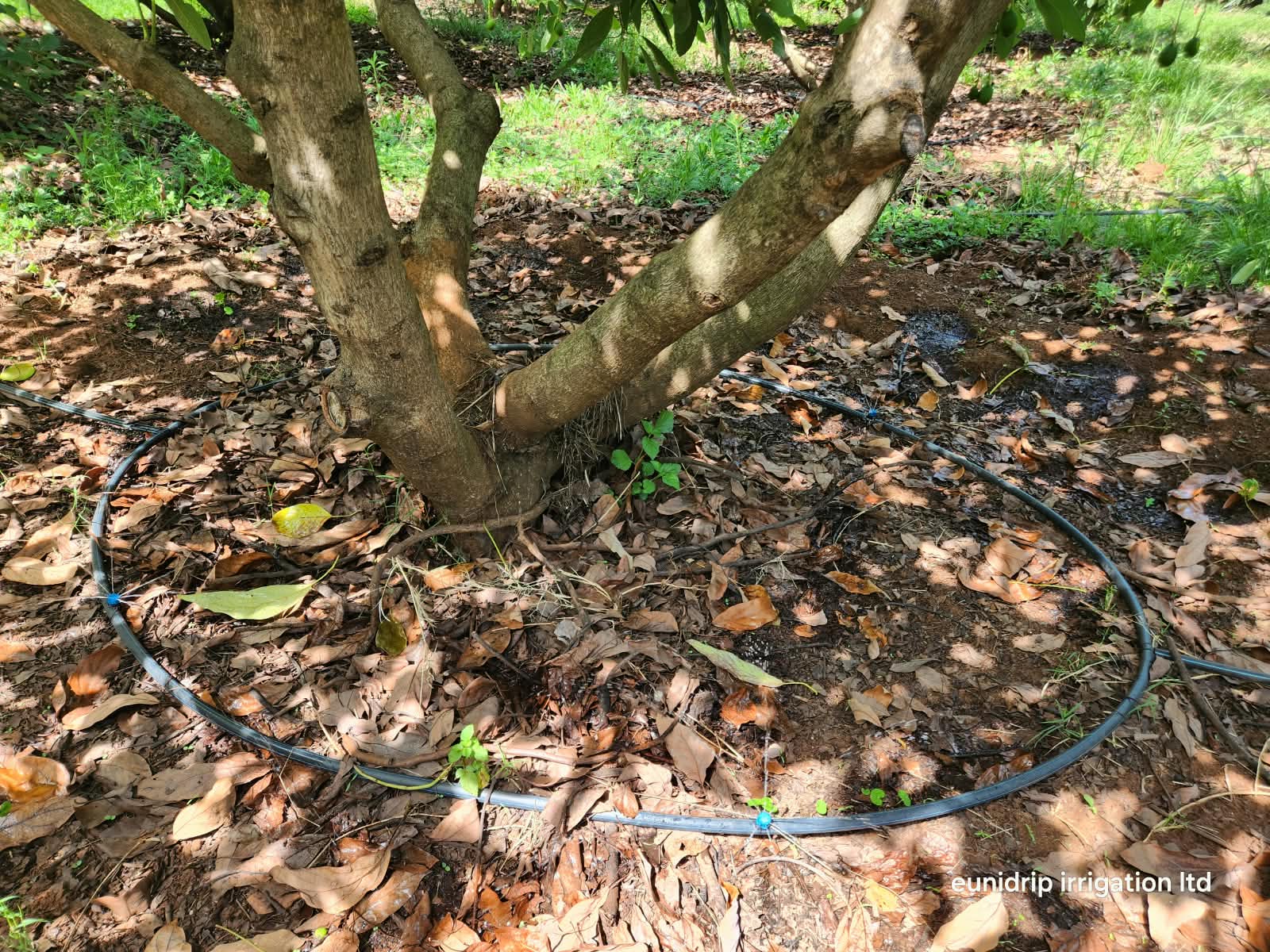
An irrigation system for avocado tree growing has to change as the tree does. Avocado farming is becoming an important source of income for many farmers in Kenya. However, a layout that watered a young tree well may not cover a mature canopy. Button drippers deliver controlled water straight to the avocado root zone. As the trees grow, you add drippers, move them outward, or bring in micro-sprinklers for wider coverage. Eunidrip supplies the drippers, pipe, filters and pumps for every stage, with countrywide delivery.
The goal is not simply to apply more water. The goal is the right amount, at the right pressure, in the right place, with as little loss as possible. If your orchard shows uneven growth, fruit abortion, wilting, dry patches around trees or ever-longer irrigation hours, the system needs an assessment.
Why Button Drippers Suit an Irrigation System for Avocado Tree Blocks
Button drippers are small emitters that release water at a fixed flow rate, typically 2, 4 or 8 litres per hour. They connect to a lateral pipe and sit at chosen points around each plant.
For young avocado trees they are ideal, because the developing root ball is small. Water goes close to the active roots instead of wetting the whole gap between trees. As a result, you waste less water and weeds get less of it too.
The main advantages for avocado growers are:
- Controlled, measurable water application per tree
- Less wastage than furrow or overhead watering
- Simple scheduling, since each dripper has a known output
- Easy to add more emitters as the tree grows
- Suitable for fertigation when the system is designed for it
- Targeted wetting of the root zone, not the inter-row
- Straightforward management of separate irrigation zones
However, the number and position of the drippers must change as the avocado tree develops. That is the point most orchards miss.
Why the Dripper Layout Must Grow with the Tree
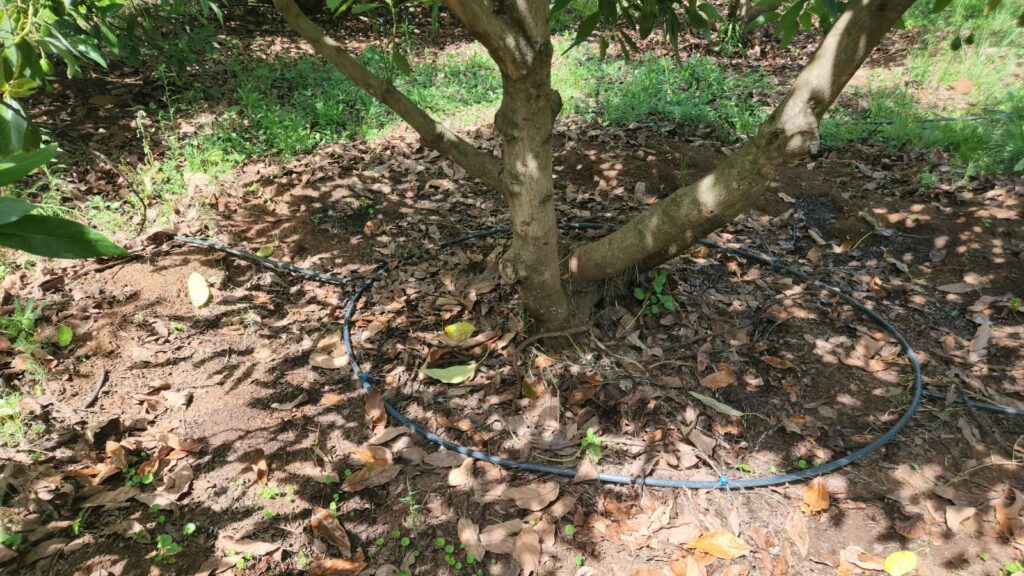
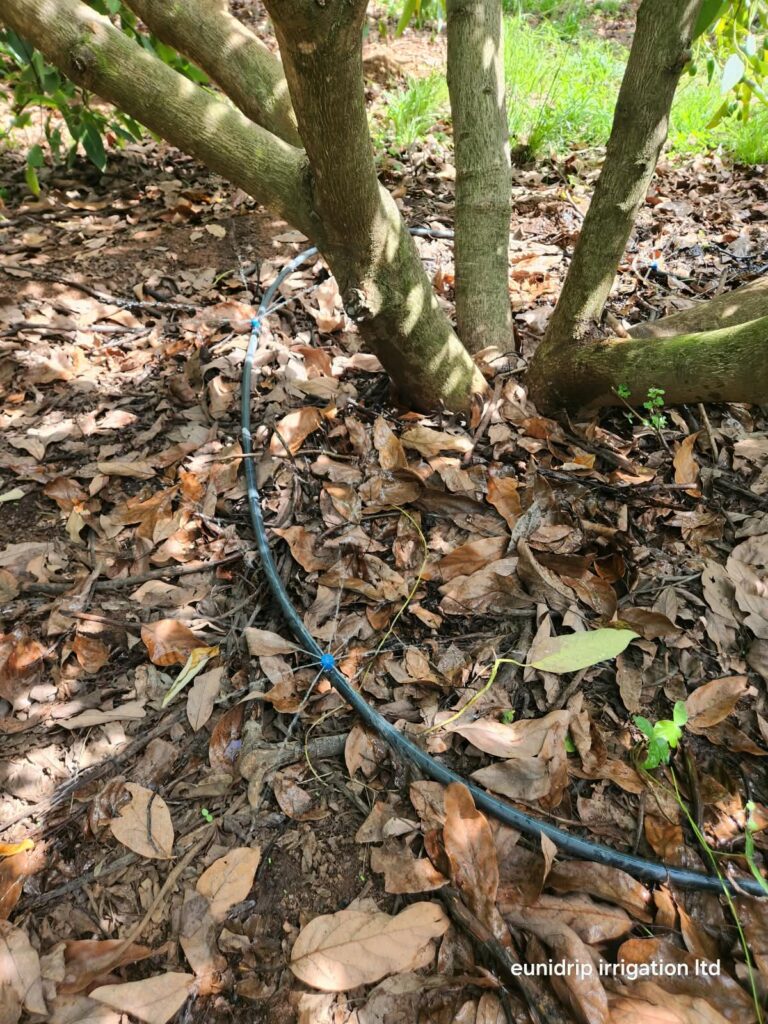
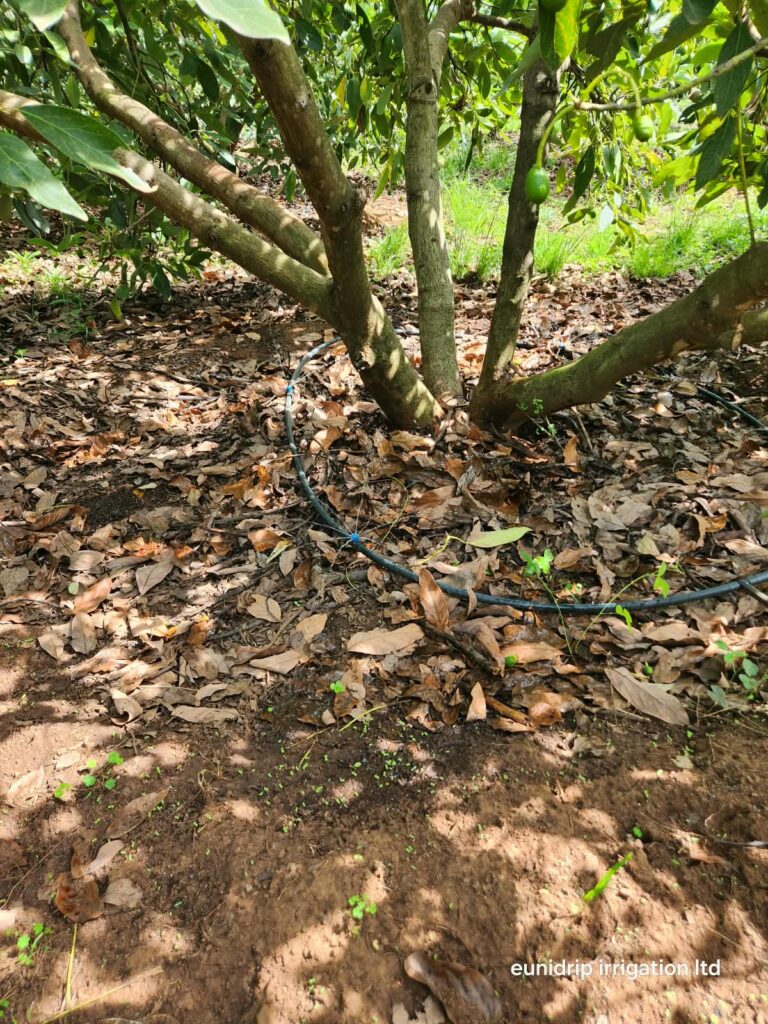
A young avocado has a small canopy and a small root system. One or two button drippers near the trunk wet enough soil for it. Meanwhile, a mature tree has roots spreading well beyond the drip line of the canopy. Keeping the same two drippers for years leaves water concentrated in a small circle. Therefore part of the active root zone stays dry, and the tree shows it.
Therefore, review these points in your irrigation system for avocado tree blocks at least once a season:
- Number of button drippers per tree
- Dripper spacing and distance from the trunk
- Dripper flow rate
- Irrigation duration and frequency
- Water pressure at the far end of each line
- Soil moisture at root depth
- The overall wetting pattern after a run
When to Upgrade an Irrigation System for Avocado Tree Orchards
There is no single tree age at which every grower should upgrade. The right time depends on tree size, spacing, soil type, water supply, climate and farm design. Instead, watch for the signs below. Any two together mean the system is behind the trees.
| Sign in the orchard | Likely cause | First thing to check |
| Trees wilting by afternoon | Too little water reaching the root zone | Dripper count and run time |
| Uneven growth across a block | Pressure loss along the line | Mainline and sub-main size |
| Dry soil under the canopy edge | Drippers still sitting at the trunk | Emitter position |
| Irrigation hours keep rising | Demand has outgrown pump or pipe | Pump capacity and zoning |
| Emitters discharging unevenly or blocking | Silt, algae or sand in the water | Filtration |
| Fruit abortion after flowering | Water stress at a critical stage | Soil moisture at 30 to 60 cm |
Five Factors When Upgrading an Irrigation System for Avocado Tree Blocks
1. Increase the number of button drippers where needed
First, adding drippers per tree is the simplest expansion of an irrigation system for avocado tree rows. As the canopy widens, extra emitters spread water across more of the root zone. Do not pick a number just because the tree is mature. Base it on tree age, canopy size, spacing, soil type, emitter discharge, available irrigation hours and water requirement.
For example, sandy soil drains fast and needs more frequent, shorter runs. Heavier soil holds water and needs fewer, longer ones. In addition, move the emitters outward as the roots spread. Drippers packed against the trunk water bark, not roots.
2. Upgrade the mainline as demand grows
Next, every dripper you add raises total flow. The mainline and sub-mains must carry it. An undersized main loses pressure, and the trees at the far end pay for it. Expect low pressure at distant trees, uneven discharge, longer run times and poor uniformity.
Size the main on total flow per zone: trees multiplied by emitters per tree multiplied by litres per hour. Our 50 mm HDPE pipe and the wider irrigation pipe range cover mains and sub-mains. Saddle clamps let you take laterals off the main without cutting it.
3. Design around practical irrigation hours
A good irrigation system for avocado tree farming delivers the day’s water inside a sensible window. Duration depends on tree count, age and canopy, water need per tree, dripper flow and count, pump capacity, pipe sizes, pressure, zone count and soil. If the orchard needs more water but the system has low flow, you end up running the pump for hours. That costs fuel or electricity and makes management harder. Therefore match the water pump to the design, not the other way round.
4. Improve filtration
Meanwhile, river, dam and borehole water carries sand, silt, algae and organic matter. All of it blocks button drippers. Clogged emitters starve some trees and leave others fine, so the block looks patchy for no visible reason. Choose an irrigation water filter by water source, water quality, system flow, emitter type and particle load. Then clean it on a schedule set by the water, not by the calendar.
5. Divide the orchard into zones
Finally, large farms should irrigate in sections rather than all at once. Zoning lets you manage available water, pump capacity, pressure, duration, fertigation, different soils and different tree ages. For example, young and mature trees need different schedules. One ball valve per zone gives you that control, and a venturi injector at the head lets you feed one zone without feeding them all.
Reading the Wetting Pattern Under the Tree
In practice, the best irrigation audit costs nothing. Water the block, wait an hour, then dig. Look at how far water spreads from each emitter, whether the soil is wet at root depth, whether some areas stay dry, whether water pools, and whether every dripper is discharging the same.
Also, do this at the far end of the line as well as near the pump. The difference between the two tells you more about pressure loss than any gauge. This simple check reveals problems that the equipment alone never shows.
Button Drippers or Micro-Sprinklers for Mature Avocados?
Both work in an irrigation system for avocado tree orchards. Drippers keep water targeted and suit limited supply. Micro-sprinklers wet a wider circle in one go, which suits a wide mature canopy on well-drained soil. Many Kenyan orchards start on drippers and move the mature blocks to micro-sprinklers once the trees meet in the row. Next, keep the drip laterals for the young replacement trees. The FAO irrigation water management guide sets out how to compare methods against your soil and water supply.
Plan the Upgrade Before Stress Becomes Serious
Assess the system before the orchard runs short. Also, check it periodically as the trees grow, and fix the weak points one at a time. A full assessment covers water source and availability, pump capacity, mainline and sub-main size, lateral sizes, dripper count and flow, operating pressure, filtration, zoning, soil moisture and run time.
Irrigation System for Avocado Tree — Frequently Asked Questions
How many button drippers does a mature avocado tree need?
Typically four to eight, spaced around the canopy edge. The right number depends on soil, dripper flow and daily water need, so count from the water requirement rather than from a rule of thumb.
How far from the trunk should the drippers sit?
On young trees, within 30 cm. As the canopy spreads, move them out to the drip line of the leaves, since that is where the feeder roots are.
Can I fertigate through button drippers?
Yes, with a venturi injector and good filtration. However, flush the lines with clean water after every feed to keep the emitters open.
Why are the trees at the end of the line smaller?
Pressure loss. Usually the mainline is too small for the flow, or the zone is too long. Split the zone or upsize the main.
Should I switch to micro-sprinklers?
Only once the canopy is wide and water supply allows it. Drippers remain the better tool for young trees and for limited water.
How often should I clean the filter?
Check it weekly in the first month. Then set the interval by how dirty it gets, which depends on your water source, not the calendar.
Where to Get an Irrigation System for Avocado Tree Farms in Kenya
Eunidrip Irrigation Systems designs and supplies avocado drip and micro-sprinkler systems from one place: drippers, laterals, mains, filters, valves, injectors and pumps. We deliver countrywide, and our team can size a block from your tree count, spacing and water source before you buy a single fitting.
Call or WhatsApp 0724 775 516 with your acreage, tree age and water source. Alternatively, use our contact page to send a farm layout. We will quote the system and the irrigation hours it needs.