

Onion irrigation systems are essential for maintaining consistent soil moisture throughout the growing season. Onions require carefully managed irrigation to support healthy vegetative growth, proper bulb formation, and good-quality yields. Both under-irrigation and excessive watering can affect crop performance, making an efficient and well-designed irrigation system an important investment for commercial onion farmers.
At Eunidrip Irrigation Systems, we design irrigation systems around the actual requirements of the farm rather than simply installing pipes and drip lines. Our approach considers water availability, farm size, elevation, irrigation hours, flow rate, pressure, pipe diameter, fittings, valves, and energy requirements.
For farmers operating less than 10 acres, a combination of solar-powered pumping, elevated water storage tanks, and low-pressure drip irrigation can provide an efficient solution. When correctly designed, the system can use gravity to distribute water from the elevated tank to the onion field while keeping energy consumption low.
Our approach is simple:
Modernizing Agriculture through efficient water and energy management.
Why Onion Irrigation Systems
Onion drip irrigation delivers water close to the crop root zone instead of distributing water over the entire field.
For onions, this can provide several advantages:
- More controlled water application
- Reduced water wastage
- Better moisture management
- Reduced unnecessary wetting of the field
- Efficient fertilizer application when fertigation is used
- Better control of irrigation schedules
- Reduced energy requirements when combined with gravity distribution
Onion irrigation should be designed according to the soil, crop spacing, bed configuration, water source, and production objectives.
For onions, this can provide several advantages:
- More controlled water application
- Reduced water wastage
- Better moisture management
- Reduced unnecessary wetting of the field
- Efficient fertilizer application when fertigation is used
- Better control of irrigation schedules
- Reduced energy requirements when combined with gravity distribution
Onion irrigation should be designed according to the soil, crop spacing, bed configuration, water source, and production objectives.
One irrigation layout that can be used for onion production is three drip lines per bed. The exact spacing should be determined according to the bed width, onion spacing, emitter characteristics, soil type, and required application rate.
Solar Power Efficiency for Onion Irrigation Systems
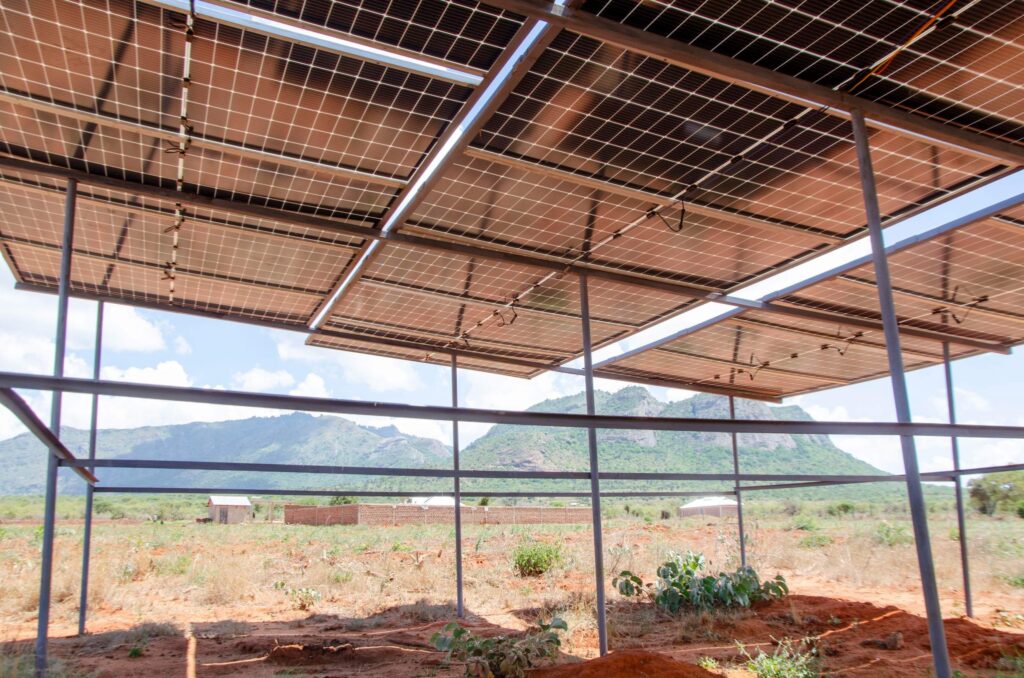
Energy costs can become a significant operating expense for farmers who rely on electrically powered or fuel-powered irrigation pumps.
Solar-powered irrigation provides an opportunity to reduce dependence on grid electricity or diesel while making use of Kenya’s abundant solar resource.
A solar irrigation system generally consists of:
| Component | Main Function |
| Solar panels | Generate electrical power |
| Solar pump/controller | Powers and controls water pumping |
| Water source | Borehole, dam, river or other source |
| Elevated tank | Stores pumped water |
| Mainline | Transports water to the field |
| Sub-main | Distributes water to irrigation blocks |
| Drip lines | Deliver water to the crop |
| Filters | Protect emitters from blockage |
| Valves | Control irrigation zones |
| Air release valves | Remove trapped air |
Instead of using the solar pump to directly pressurize the entire irrigation network throughout the irrigation period, the pump can be used to lift water into an elevated storage tank.
The stored water can then be distributed using gravity.
This creates two separate stages:
Solar energy → Pumping and storage
Gravity → Field irrigation
This arrangement can improve energy efficiency and make irrigation easier to manage.
Why Elevated Tanks Are Effective for Farmers Below 10 Acres
Elevated tanks can be particularly useful for small and medium-sized farms.
For a farm of less than 10 acres, an appropriately sized tank can store sufficient water for scheduled irrigation blocks. Water is pumped into the tank during solar pumping hours and then released to the field when irrigation is required.
The elevation of the tank creates gravitational pressure.
The basic principle is:
Greater elevation difference = greater available gravitational pressure.
However, tank height should not be selected simply by guessing how high the tank should be. The required elevation must be calculated against the hydraulic losses in the system and the operating requirements of the drip lines.
The available pressure must overcome:
- Mainline friction
- Sub-main friction
- Fitting losses
- Valve losses
- Filter losses
- Elevation changes
- Drip-line requirements
This is why hydraulic design is important even in a gravity-fed irrigation system.
Low-Pressure for Onion Irrigation Systems
One important characteristic of this type of system is that the irrigation network can operate at relatively low pressure.
Depending on the selected drip components and hydraulic design, the pressure at the irrigation system exit can be below 2 bar.
The objective is not to create the highest possible pressure.
The objective is to provide adequate pressure for uniform irrigation.
Excessive pressure can create unnecessary stress on the system and may require pressure-regulating equipment.
The design should therefore ensure that the available gravity pressure is sufficient to operate the selected drip lines while maintaining acceptable pressure across the irrigation block.
For example, if the system has adequate pressure at the beginning of the irrigation block but insufficient pressure at the farthest point, the problem may not be the tank. It may be caused by:
- Undersized mainline
- Excessive pipe length
- Too many fittings
- Restrictive valves
- Dirty filters
- Poorly designed manifolds
- Excessive elevation difference
Three Drip Lines Per Onion Bed
A three-line-per-bed configuration can provide an efficient distribution arrangement for onion production where the bed dimensions and crop spacing make it appropriate.
The system can be arranged so that three drip lines serve each planting bed.
However, the number of lines should not be determined in isolation. The designer must consider:
- Bed width
- Onion spacing
- Drip-line spacing
- Emitter spacing
- Emitter discharge
- Soil infiltration characteristics
- Required irrigation depth
The objective is to create a sufficiently uniform wetting pattern around the onion root zone.
Mainline Size and Irrigation Hours
One of the most important technical considerations in irrigation design is the size of the mainline.
The mainline must be capable of carrying the required flow within the farmer’s available irrigation hours.
This means that pipe sizing should begin with the question:
How much water needs to be delivered, and how quickly does it need to reach the field?
For example, if a farmer needs to deliver a particular volume of water within four hours, the required flow rate will be higher than if the same volume can be delivered over eight hours.
Therefore:
Shorter irrigation time → Higher required flow rate
Longer irrigation time → Lower required flow rate
The mainline must then be selected to handle this flow without excessive pressure loss.
Relationship Between Flow Rate, Pressure and Mainline Size
Flow rate, pressure, and pipe diameter are closely related.
When more water is forced through a small pipe, water velocity increases. Higher velocity generally results in greater friction losses.
Conversely, a larger pipe can carry the same flow at a lower velocity and typically produces lower friction losses.
The basic relationship can be understood as:
| Design Condition | Expected Effect |
| High flow + small pipe | High velocity and higher pressure loss |
| High flow + large pipe | Lower velocity and reduced pressure loss |
| Low flow + appropriately sized pipe | Efficient water movement |
| Long pipe + high flow | Greater friction loss |
| Short pipe + moderate flow | Lower friction loss |
This does not mean that the largest possible pipe should always be installed.
Oversizing the entire network can unnecessarily increase project costs.
The goal is to find the appropriate balance between capital cost, flow requirement, pressure availability, and irrigation time.
What Happens When the Mainline Is Too Small?
An undersized mainline can create significant hydraulic problems.
The farmer may experience:
- Low pressure at the end of the system
- Uneven water distribution
- Longer irrigation periods
- Poor drip-line performance
- Increased pump requirements
- Higher energy consumption
For example, if a system requires a high flow rate but the mainline is too small, the water velocity increases and more pressure is consumed overcoming friction.
This can leave insufficient pressure for the downstream drip lines.
The farmer may then incorrectly assume that the pump needs to be upgraded.
In reality, the problem could be an incorrectly sized mainline.
Connector Pressure Loss in Irrigation Systems
Water does not only lose pressure while travelling through straight sections of pipe.
Pressure is also lost when water passes through fittings and components.
These include:
- Elbows
- Tees
- Couplings
- Reducers
- Valves
- Filters
- Manifolds
- Connectors
Every fitting creates some resistance to water movement.
This is known as minor or local pressure loss, although the combined effect can become significant in a complex irrigation network.
A system containing many fittings may therefore have greater pressure loss than a simple pipeline of the same length.
Effect of Pressure Losses on Fittings and Valves
Valves and fittings must be selected according to the expected flow rate.
A valve that is too small can restrict the system and cause a significant pressure drop.
Similarly, a poorly selected connector can create unnecessary resistance.
For a gravity-fed system, this is particularly important because the available pressure is limited by the elevation of the tank.
If too much pressure is consumed by fittings and valves, insufficient pressure may remain for the drip lines.
This can result in:
- Reduced flow at distant emitters
- Uneven irrigation
- Longer irrigation times
- Reduced system efficiency
The designer should therefore consider the pressure loss of the entire hydraulic network rather than looking only at the main pipe.
The Role of Air Release Valves in a Gravity Irrigation System
Air management is an important part of gravity-fed irrigation.
Air can accumulate inside pipelines, particularly at high points where the pipeline rises and then falls.
An air release valve allows trapped air to escape from the system.
This is important because an air pocket can interfere with the continuous movement of water.
Potential effects include:
- Reduced flow
- Irregular pressure
- Difficulty filling the pipeline
- Interruption of water movement
- Increased hydraulic resistance
In a gravity system, maintaining a continuous water column is particularly important because the system relies on elevation rather than continuous pump pressure.
Where Should Air Release Valves Be Installed?
Air release valves are generally considered at high points of the pipeline profile.
During system design, the farm should therefore be surveyed to identify changes in elevation.
A pipeline running across uneven terrain may have several high points where air can accumulate.
The location of air release valves should be determined from the actual pipeline profile and hydraulic design.
This is one reason why professional irrigation design is more than simply measuring the distance between a tank and a farm.
Why Water Flow Should Minimize Unnecessary Turbulence
Efficient irrigation systems should encourage smooth and controlled water movement.
Turbulence itself is not automatically a problem—water flow in irrigation pipes will often be turbulent. The objective is to avoid unnecessary turbulence and hydraulic disturbances caused by poor system design.
Excessive turbulence and sudden changes in flow direction can increase energy losses and contribute to pressure variations.
This becomes especially important in systems operating with relatively low pressure.
How to Reduce Turbulence During Irrigation Design
Several design considerations can help reduce unnecessary hydraulic losses.
Avoid Unnecessary Bends
A straight pipeline generally creates less resistance than one containing numerous sharp turns.
Where practical, the pipeline route should be planned to minimize unnecessary bends.
Avoid Sudden Pipe Reductions
A sudden transition from a large pipe to a significantly smaller pipe can increase velocity and create additional hydraulic losses.
Pipe reductions should be properly calculated.
Use Correctly Sized Fittings
Fittings should match the required flow.
Using very small connectors in a high-flow section can create significant resistance.
Avoid Excessive Valves
Valves are necessary for controlling irrigation blocks, but unnecessary restrictions should be avoided.
Correctly Size the Mainline
A properly sized mainline helps maintain reasonable flow velocity and reduces friction losses.
Design the Manifold Properly
The manifold should distribute water evenly to the irrigation blocks without creating unnecessary restrictions.
Designing an Efficient Gravity-Fed Onion Irrigation System
At Eunidrip Irrigation Systems, we consider the entire hydraulic system when designing onion irrigation.
The basic system can be represented as:
Water Source → Solar Pump → Elevated Tank → Mainline → Control Valve → Sub-main → Manifold → Three Drip Lines per Bed → Onion Crop
The available pressure from the elevated tank must be sufficient to overcome the losses between the tank and the drip lines.
These losses include:
Pipe friction + fittings + valves + filters + elevation changes
The remaining pressure should be sufficient for the selected drip irrigation equipment.
What Eunidrip Considers During System Design
A professional onion irrigation system should be designed from actual farm data.
At Eunidrip Irrigation Systems, important design considerations include:
| Design Parameter | Why It Matters |
| Farm size | Determines total irrigation requirement |
| Water source | Determines pumping requirements |
| Tank elevation | Determines available gravity pressure |
| Irrigation hours | Determines required flow rate |
| Mainline diameter | Controls velocity and friction loss |
| Pipe length | Affects pressure loss |
| Terrain | Determines elevation changes |
| Drip-line specification | Determines operating requirements |
| Number of irrigation blocks | Determines simultaneous flow |
| Fittings and valves | Contribute to pressure loss |
| Air-release points | Prevent trapped air |
| Soil type | Influences irrigation scheduling |
This approach allows the irrigation system to be designed around the farm rather than forcing the farm to adapt to a standard package.