

Table of Contents
Onion farming looks simple from the roadside and unforgiving from the field. The crop has shallow roots, a short window for every job, and a market that pays for size and firmness. This guide covers the field side of onion farming in Kenya, from variety choice to the sack that leaves the farm. If your water comes from a drip line, the kit page explains the hardware. Here the subject is the crop itself.
Why onion farming in Kenya rewards steady water
An onion root system reaches about 30 cm into the soil, which is shallow for a crop that spends four months building a bulb. That shallowness explains most of the failures. A dry week at bulbing costs size. Then a wet week after the tops fall invites rot. Neither mistake is visible until the harvest is weighed.
Steady moisture is the whole game. A field that receives the same small amount of water every day produces firm, even bulbs. A field that swings between flood and drought, however, produces thick necks, split skins and a crop that will not store. In practice, the growers who succeed are the ones who fix the water system before they fix anything else.
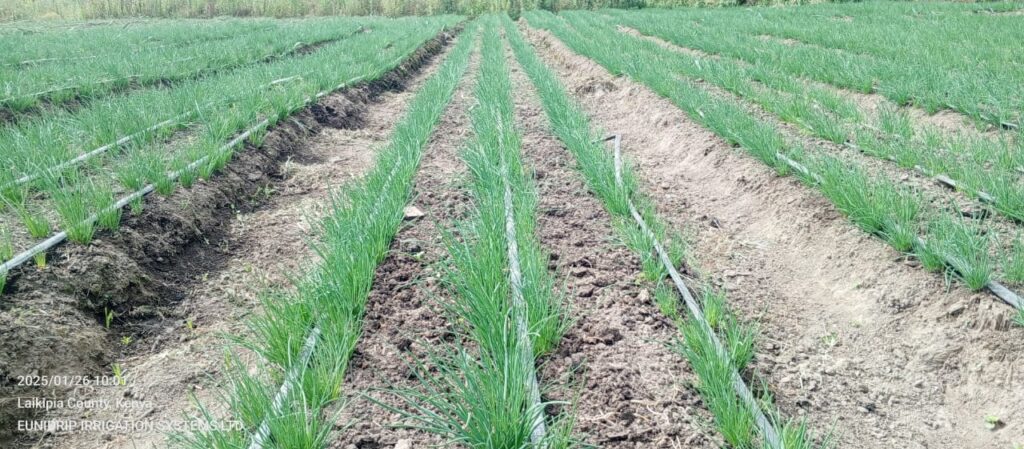
The varieties that suit Kenyan onion farming
Onion varieties are grouped by day length. A short-day variety starts bulbing when daylight reaches roughly 11 to 12 hours, which suits most Kenyan growing regions. A long-day variety, in contrast, waits for 14 hours or more and then keeps growing leaves instead of forming a bulb. Because of that, seed choice is not a preference; it decides whether the crop will bulb at all.
Three names come up repeatedly in Kenyan fields. For example, Red Creole and Bombay Red are short-day reds with good skin and a strong market. Texas Grano is an intermediate type that bulks well where the season runs long. Ask for the maturity days when you buy seed, because a variety that needs 150 days will not fit a short rain season.
| Variety | Day length | Why growers pick it |
|---|---|---|
| Red Creole | Short | Dependable red bulb, stores well |
| Bombay Red | Short | Early, strong colour, steady demand |
| Texas Grano | Intermediate | Large bulb where the season is long |
Seven steps from seedbed to sack
Onion farming is a sequence, and each step has a deadline. As a result, skipping one shows up two months later, when the bulb is already formed and nothing can be corrected.
Step 1: Set the planting window
First, work backwards from the market you want. Onions need 6 to 8 weeks in the nursery and 3 to 4 months in the field, so a crop planted in March is harvested around July. Match that date to the rain pattern in your area, not to the calendar in a seed catalogue.
Step 2: Raise strong seedlings
Sow seed in a fine, well-drained nursery bed and keep it moist but never flooded. Because damping off kills crowded seedlings, thin them early. A seedling is ready when it reaches pencil thickness, roughly 6 to 8 weeks after sowing.
Step 3: Prepare and transplant the beds
Specifically, onions want a fine tilth and a pH between 6.0 and 6.8. Build beds about 1 m wide so you can weed from both sides. Transplant in the cool of the evening, trim the roots slightly, and set the plants so the white base sits just at soil level.
Step 4: Feed in two passes
Onion roots will not travel far to find phosphorus, so place it in the row at planting instead of broadcasting it across the bed. Top-dress nitrogen 4 to 6 weeks later, while the leaves are still building. Stop heavy nitrogen after bulbing starts, or the necks stay thick and the bulbs will not keep.
Step 5: Water little and often
This is the step that decides the crop. Give the field a small, measured amount every day or two rather than a heavy soak each week. A drip irrigation kit for onions does this without labour and keeps the leaves dry.
Step 6: Weed early and mulch lightly
Onion seedlings lose a weeding contest against almost anything. For this reason, clear the beds in the first three weeks, before the leaves close the row. A light mulch holds moisture and keeps the soil from splashing disease onto the leaves.
Step 7: Scout for thrips and purple blotch
Walk the field with the leaves turned over. Thrips scar the leaf surface and leave a silvery streak. Similarly, purple blotch starts as small white lesions with a purple centre. Catch either early and you treat a patch. Catch it late and you lose the leaf area that feeds the bulb.
Watering: where onion farming in Kenya succeeds or fails
Irrigation is the one input you control completely, and it is the input that decides bulb quality. The table below sets out what the crop needs at each stage. The volumes are a guide for a normal season, not a prescription, because soil type changes them.
| Stage | Water | What to check |
|---|---|---|
| Nursery | Light daily misting | Damping off in crowded beds |
| After transplant | Daily for two weeks | Root establishment, no wilting |
| Vegetative growth | Steady, every day or two | Even leaf colour, no dry tips |
| Bulbing | Steady, never stress | Bulb swelling, soil moisture at 30 cm |
| Ripening | Stop two to three weeks out | Tops falling, skins firming |
Stop watering 2 to 3 weeks before harvest. Typically, that dry period firms the skin and lets the necks close, which is what makes the difference between onions that store for months and onions that rot in a week. On a drip tape system the stop is simple: close the valve, or set the timer off.
The costs that decide whether onion farming pays
Seed, fertiliser, labour and water are the recurring costs. The irrigation system is the capital cost, and it is the one that changes the labour bill permanently. A field watered by hand needs a person every day; a field on a timed line needs a check every few days. The 1 acre drip irrigation kit lists the hardware a block of that size needs, so the capital figure is not a guess.
Budget the four recurring costs for the whole season before you plant. Onion farming fails quietly when the money runs out at bulbing, because that is exactly when the crop needs its last fertiliser and its steadiest water.
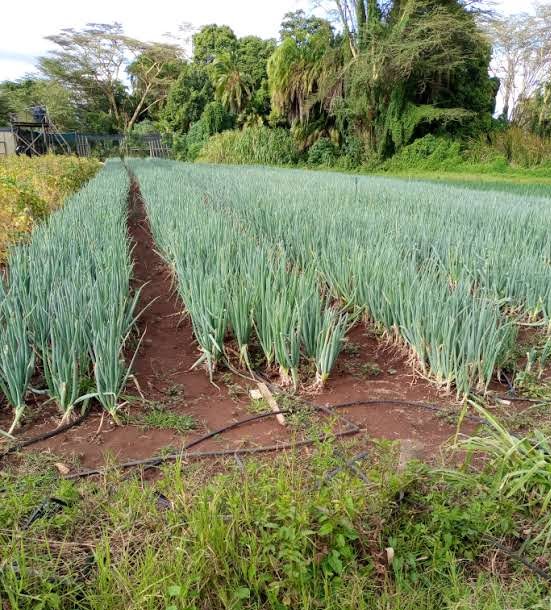
Harvest, curing and storage
Harvest when half to three quarters of the tops have fallen. Lift the bulbs with a fork rather than pulling, and leave them in the field for a few days if the weather is dry. Then move them to shade, because direct sun bleaches and softens the skins.
Cure for 2 to 3 weeks in a dry, airy place until the necks are tight and the outer skins rustle. Finally, cut the tops about 2 cm above the bulb, then trim the roots. Store in mesh bags or shallow trays, never in a sealed sack, and inspect every 2 weeks for soft bulbs.
Mistakes that cost onion farming in Kenya a season
Most losses come from a short list. Seedlings go into the field too late and meet a rain season that ends early. Nitrogen keeps going on after bulbing, so the necks never close. Water is cut too abruptly, or not cut at all. Thrips are treated after the leaf is already scarred. Bulbs are lifted wet and stored without curing.
Each one is cheap to prevent and expensive to fix. Therefore, keep a notebook with the planting date, the fertiliser dates and the day you stop watering, because next season’s decisions depend on this season’s record.
Frequently asked questions about onion farming
How long does onion farming take in Kenya?
Plan on 4.5 to 5 months. The nursery takes 6 to 8 weeks, and the field crop needs another 3 to 4 months, depending on the variety and the altitude.
Can onions be grown without drip irrigation?
Yes, but hand watering rarely delivers the same consistency. Onions need small, regular amounts, and a drip line does that with less labour and less leaf wetting.
What spacing should I use for onions?
10 cm between plants and 15 cm between rows is a common field spacing. Wider spacing gives larger bulbs; tighter spacing gives more bulbs per bed.
Why do my onions form thick necks?
Usually excess nitrogen late in the season, or water that continues after the tops fall. Thick necks cure badly and rot in store.
How long can onions be stored after harvest?
Well cured bulbs in a dry, ventilated store hold for 2 to 3 months. Poor curing and damp storage cut that to a few weeks.
For the greenhouse version of the same crop, the greenhouse onion farming guide covers climate control and spacing under cover. If you are still choosing a watering method, the drip irrigation systems in Kenya comparison sets out the alternatives. Onion biology, day length and storage behaviour are documented in more depth elsewhere. Nothing here replaces a soil test, and nothing here replaces a walk through your own field every week.