

Table of Contents
Button drippers are the small barbed emitters you press into a 16 mm lateral, or onto a length of micro-tubing, to water a single plant. Each body takes water at a fixed or a settable rate. Rates run from half a litre an hour on a pot to 70 litres on the largest body. That one figure then sets emitter spacing, the longest lateral you can run, and the block pressure.
The three types on sale in Kenya differ on one question. What happens to the flow when pressure drops along the line? Adjustable bodies let you turn the rate by hand. Pressure-compensating bodies hold the same rate from the first emitter to the last. Plain bodies are cheap and even, provided the run is short and level. Consequently, the choice is rarely about quality, and it is almost always about the field.
How button drippers attach to a lateral
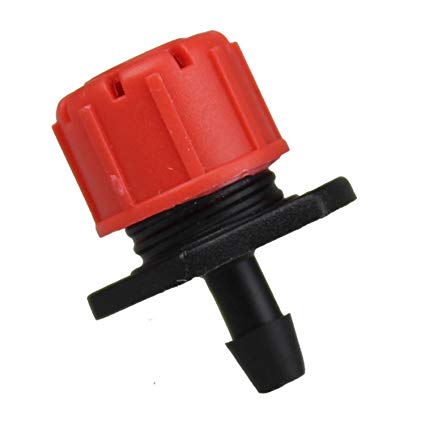
A button dripper presses into a punched hole in the lateral. Its barbed inlet grips the wall, and a barbed outlet above accepts micro-tubing. Both barbs matter. First, the inlet has to match the pipe. A body moulded for 12 mm will leak from a 16 mm wall. Next, the outlet lets you move water away from the line. That is how a tree planted 40 cm off the row still gets watered.
Punching is the only installation step, and it decides how long the emitter stays put. In practice, a punch made for the lateral cuts a clean round seat. A nail leaves a tear that widens under pressure. Also press the body home until the flange sits flat. An emitter standing proud of the pipe will blow off the first time the line is flushed. Because the outlet stands clear of the pipe, the water drops at the plant instead of running along the lateral.

The three types of button drippers
The table sets the three families side by side. It uses the rates and the prices the shop lists for each. Read down the fourth column first, because pressure behaviour is what separates them in a field.
| Type | Flow options | Price a piece | Under falling pressure | Where it fits |
|---|---|---|---|---|
| Adjustable. | 0 to 70, 0 to 180 and 0 to 200 litres an hour, plus a fixed 8 L/h body. | KSh 10 to 30. | Falls, and moves when the cap turns. | Pots, planters, tree establishment. |
| Pressure-compensating. | 2, 4, 8 and 16 litres an hour. | KSh 10 to 20. | Holds its rated flow. | Long laterals, slopes, one rate a block. |
| Non-adjustable. | One factory rate for each body. | Not listed on its own. | Falls, evenly across the block. | Nurseries, short level runs. |
Prices are per piece. Therefore a 500-tree block at two emitters a tree needs KSh 10,000 to 15,000 of drippers. That is the smallest line in the budget.
Adjustable button drippers: turn the flow by hand
An adjustable body carries threads on the crown. A cap rides up and down them, and turning it widens or narrows the opening. One emitter therefore covers a range instead of a single rate. The shop lists three adjustable ranges, 0 to 70, 0 to 180 and 0 to 200 litres an hour. A fourth body is fixed at 8. For this reason, an adjustable dripper is the only type that can be re-set after planting without being replaced.
However, a turned cap stores nothing. Nobody writes down where it points, and the setting moves whenever a worker drags a hose across the line. Flow also follows pressure. The last emitter on a long run delivers less than the first, even at the same mark. Therefore, use it where you will keep walking the line, not where you set it once and leave it.
Planters, large pots and young trees in a mixed block are the natural home. In addition, a trial row is easy to set up. Turn half the emitters to 4 litres an hour and half to 8, then watch which responds.
Pressure-compensating button drippers: one rate down the line
A diaphragm inside closes as pressure rises and opens as it falls. Consequently, the emitter delivers its rated flow across a working band, from roughly 1 bar upwards on most bodies. The shop lists 2, 4, 8 and 16 litres an hour. Because the rate is fixed at the factory, the printed code is the only way to tell two bodies apart.
Where this pays is length and slope. A 100 m lateral on a 5% slope runs the first emitter fast and the last one slow. On a compensating body the same line delivers evenly. The block can be longer, and the pump can run at lower pressure. As a result, the extra few shillings a piece is usually recovered in pipe and pumping.
Compensating bodies need a minimum pressure to open. Keep that in mind on a gravity tank: below the opening pressure the diaphragm stays shut, and the block starves. Typically, a tank 10 m above the field clears it. A tank on a 2 m stand does not.
Non-adjustable button drippers: the cheap, even body
A plain body has no threads and no cap. It is moulded in polyethylene, in a UV-stabilised grade that holds up in the sun, and the same plastic resists the fertiliser salts carried in the water. The manufacturer fixes the flow, and every identical body in the box behaves the same way. Because there is nothing to turn, nothing drifts either. That makes it the easiest type to audit. Count the emitters and multiply by the rated flow.
The catch is pressure. Identical bodies give identical flow only when they see identical pressure. First, keep the runs short. Next, keep the ground close to level. Then the same body will water evenly across a nursery bench or a kitchen garden. Beyond about 60 m, or across a real slope, the far end falls behind.

Flow rate and spacing: matching button drippers to a crop
Two numbers decide the layout. One is how much water the plant needs at peak, and the other is how many emitters feed it. For example, a mature avocado in a hot month may draw 60 to 100 litres a day. Four 16 litre emitters cover that in under two hours. One 4 litre emitter would need seven hours. That still works on a timer, though the wetted area is a single point.
Orchard crops carry the widest spread of layouts. Avocado, mango and orange trees take two to four emitters, banana suckers take one, and a lawn or a ground cover bed runs on the same close spacing as a vegetable row.
Vegetables want emitters closer together. On a 16 mm lateral for tomato, space button drippers at 30 to 50 cm, one line a row. Typically, a 50 m row at 30 cm carries about 170 emitters, or 340 litres an hour. Because the demand is known, the filter and the main line can be sized without guesswork.
Trees take fewer. In the first season, one emitter a tree, at the edge of the canopy rather than against the trunk. In the second season, move it out, or add a second one. By the third year most orchard blocks carry two to four emitters a tree. Meanwhile, the run time shortens as the emitters are added.
Pots and planter boxes take one 2 litre body each. Because the volume is small, that emitter fills a 20 litre pot in ten minutes. The same body on a 200 litre planter needs a hundred minutes. That is long enough to justify a second emitter.
Pressure, filtration and clogging
Plain button drippers run best between 15 and 25 PSI. Below that, the pattern at the outlet weakens and the wetted area shrinks. Above it, the body can blow off the punch, and the flow climbs with the pressure. Compensating bodies tolerate a wider band, hence their use at the far end of a long block.
Filtration protects the flow path. A 120 mesh screen removes the grit and the organic matter that wedge into the labyrinth. Inside, that path is a labyrinth that keeps the flow turbulent, so particles are carried through instead of settling. Also flush the laterals at the end of every season. Pull the last emitter, or open the flush valve, and let the line run clear. Sand settles wherever the water slows, so the first emitters in a run collect it.
Hard water is the other risk. If the source leaves a white ring on a bucket, the calcium will scale the emitter. Then an acid flush twice a season keeps the passages open. The FAO drip irrigation manual sets out the water-quality thresholds behind that routine.
What button drippers cost in Kenya
Adjustable bodies run from KSh 10 to KSh 30 a piece. Compensating bodies run from KSh 10 to KSh 20. A plain body sits below both on price, and the listed range starts at KSh 10. Arrow drippers, which run from micro-tubing with a longer spout, cost about KSh 60 each. For this reason, a small holding can be fitted for about the price of a bag of fertiliser.
The emitters are rarely the expensive part. A 100 m lateral, a filter and a main line cost more than the drippers sitting on it. Consequently, the choice of body should follow the field. Saving KSh 5 a piece on a sloping block costs more in yield than it saves in hardware.
Button drippers compared with drip tape and micro-tubing
Drip tape is cheaper per metre and better suited to rows. One tape runs down each row of vegetables, with outlets already spaced. Drip of either kind needs no land levelling, and water goes only where the roots are, which holds weeds down and keeps losses small. Button drippers cost more per plant, and they last longer. The body is a solid moulding rather than a thin wall. Similarly, micro-tubing is cheap to buy and easy to move, although it clogs faster and perishes in the sun.
Use the rule of the planting. If the crop is replanted every season and the rows are close, tape wins. If the plant stays for five years or more, and each one needs its own wetting point, button drippers win. In practice, most Kenyan orchards end up with compensating bodies on a mulched or buried lateral.
Our article on button dripper irrigation for avocados walks that orchard layout through with field photographs. This page covers the emitter decision itself. The shop carries the adjustable button drippers and the pressure compensation button dripper bodies at these prices.
Frequently asked questions
How many button drippers per tree?
One at planting, two in the second year, and two to four once the canopy fills. Split the daily demand across those emitters instead of raising the flow rate on one. A single point wets a small volume of soil.
What flow rate suits tomatoes?
2 litres an hour at 30 cm is the common Kenyan layout for tomato on a 16 mm lateral. At that spacing a 50 m row carries about 170 emitters, which is 340 litres an hour. A 20 minute run then puts about 110 litres on the row.
Can button drippers run from a gravity tank?
Plain and adjustable bodies can, as long as the tank gives about 15 PSI at the outlet. That is close to 10 m of head. Compensating bodies need their opening pressure first, so check it against the height you can build.
How often should they be cleaned?
Flush the lateral at the end of every season. Clean the irrigation water filters whenever the pressure gauge across the screen drops. In hard water, add an acid flush twice a season.
Do the colours mean anything?
On many brands the body colour marks the flow rate. However, the shop stocks several colours in the same flow, so colour alone cannot be trusted. In this shop the colour is an identification code, then, and not a performance grade. Read the printed code on the body instead, and compare it with the invoice.
What is the difference between a button dripper and an arrow dripper?
A button dripper presses straight into the lateral. An arrow dripper runs from micro-tubing and carries a longer spout. It suits a plant set well off the line, and it costs about KSh 60 a piece.
Should one farm use a single type?
Not necessarily. Compensating bodies on the orchard and plain bodies in the nursery is a normal split. The two blocks differ in run length and pressure. Therefore, pick per block, and keep the type written on the field plan.
Whichever of the three button drippers you choose, match the body to the pressure the line will actually see. That single check prevents most of the complaints that follow a new installation.