
Description
Tractor PTO Driven Blower Chaff Cutter for Sale in Kenya
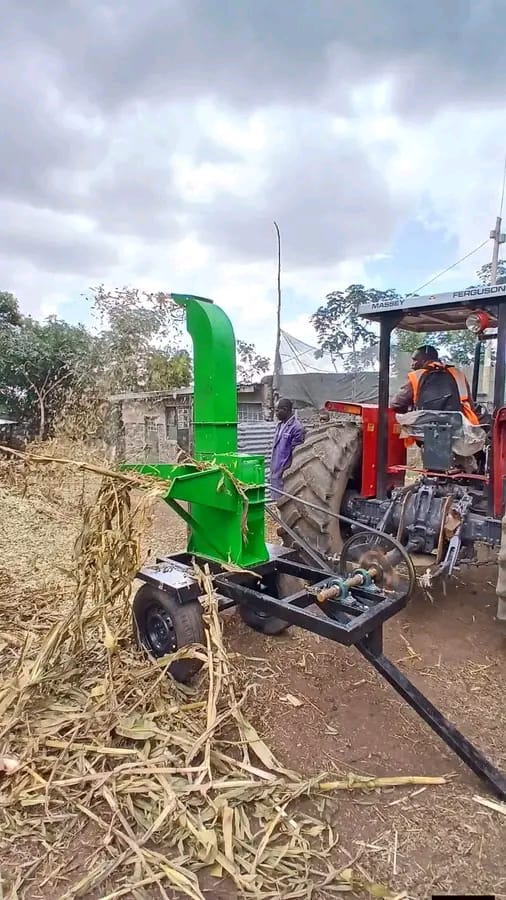
A Tractor PTO Blower Chaff Cutter is an agricultural machine that uses a tractor’s PTO shaft to power its cutting and material-discharge mechanisms. Most of its body parts are locally assembled and welded.
The Tractor PTO Blower Chaff Cutter is designed to chop suitable fodder into smaller pieces using power supplied directly from a tractor. It operates through the tractor’s Power Take-Off (PTO) system, which transfers rotational power to the machine’s cutting mechanism.
What makes this equipment particularly useful is its blower-assisted discharge system. After chopping, the machine helps propel the processed fodder through an outlet, making it easier to direct the material into a trailer, trolley or collection area.
This equipment is suitable for commercial dairy farms, livestock projects, fodder producers and agricultural contractors looking for a tractor-operated solution for bulk fodder preparation.
Instead of depending on a separate engine or electric motor, the machine receives mechanical power from the tractor. The rotating cutting assembly chops the fodder, while the blower system assists in moving the chopped material through the discharge outlet.
The main machine body houses the cutting mechanism, feeding section and discharge arrangement. Its design allows suitable forage to be processed continuously when operated within the manufacturer’s recommended limits.
It is useful for:
- Commercial dairy farms.
- Large zero-grazing operations.
- Livestock feed preparation centres.
- Farmers producing silage.
- Agricultural contractors offering fodder chopping services.
- Farms handling large quantities of Napier grass and crop residues.
How the Tractor PTO Driven Blower Chaff Cutter Works
The machine operates through a series of connected mechanical processes.
1. Tractor connection
The chaff cutter is connected to a compatible tractor using a PTO shaft. The tractor must have sufficient power to operate the machine safely and effectively.
2. Power transmission
When the tractor PTO is engaged, rotational power passes through the PTO shaft and drive arrangement to the machine.
3. Fodder feeding
The operator introduces suitable grass or crop residues through the feeding inlet. The material moves towards the cutting assembly.
4. Cutting process
Rotating blades cut the incoming fodder into smaller pieces. The final particle length depends on the blade configuration, feeding speed and machine design.
5. Blower-assisted discharge
The blower mechanism helps propel the chopped material through the discharge outlet. This allows the operator to direct the material towards a suitable collection point.
Tractor PTO Driven Blower Chaff Cutter Specifications
When selecting a tractor-operated chaff cutter, it is important to consider tractor compatibility, PTO speed, blade configuration and hourly output.
The following table provides indicative specifications for comparable heavy-duty machines. The exact figures should be confirmed against the manufacturer’s specification plate for the particular Eunidrip model.
| Specification | Indicative details |
|---|---|
| Product name | Tractor PTO Blower Chaff Cutter |
| Machine category | Tractor-operated chaff cutter |
| Power source | Tractor Power Take-Off |
| Tractor power | Approximately 35HP and above, subject to model |
| PTO speed | Commonly 540 RPM; confirm machine requirement |
| Cutting mechanism | Rotating blades and flywheel assembly |
| Number of blades | Model-dependent |
| Cutting length | Model-dependent; adjustable on selected models |
| Discharge system | Blower-assisted discharge |
| Suitable materials | Napier grass, maize stalks and suitable forage |
| Application | Livestock feed preparation and silage chopping |
Output Capacity
Output capacity is an important factor for farmers investing in mechanised fodder preparation equipment. On good working scale of 5 ton/ hour.
Actual output depends on several factors:
- Tractor horsepower and available PTO power.
- PTO operating speed.
- Width and design of the feeding inlet.
- Number, sharpness and arrangement of cutting blades.
- Thickness and maturity of the fodder.
- Moisture content of the material.
- Operator feeding rate.
- Blower and discharge design.
The Blower Discharge System
The blower is an important part of this machine’s material-handling arrangement. Once the blades cut the fodder, the chopped material needs to move out of the cutting chamber. The blower helps propel it through the discharge outlet. This offers several practical advantages.
Easier Fodder Collection
The discharge outlet can be positioned towards a collection point, reducing the need to gather all the chopped material directly from beneath the machine.
Convenient Loading into Trailers
Where the outlet height and direction are suitable, chopped fodder can be directed into a trailer or trolley. This is useful for farms preparing large batches of feed.
Continuous Material Movement
The blower assists in moving chopped material away from the cutting area, supporting the machine’s overall processing operation.
Better Organisation of the Working Area
A suitable collection arrangement helps farmers manage chopped fodder and transport it to feeding areas or silage storage locations.
Fodder Materials Processed by a Tractor PTO Driven Blower Chaff Cutter
The machine can process different agricultural materials, depending on its cutting design and manufacturer’s recommendations.
Napier Grass
Napier grass is one of the most widely used fodder crops among Kenyan dairy farmers. Its long stems can be chopped into smaller pieces for easier handling and distribution during stall feeding.
Maize Stalks and Leaves
Maize residues left after harvesting can be processed into smaller portions for appropriate livestock feeding applications. This allows farmers to make productive use of available crop residues.
Sorghum Fodder
Suitable sorghum varieties can be chopped for livestock feeding or forage preservation. Farmers growing sorghum as animal feed can use the machine to prepare harvested material.
Hay and Dry Grass
Where the machine is designed for dry materials, hay and other dry grass can also be processed into smaller pieces.
Benefits of Using a Tractor PTO Driven Blower Chaff Cutter
1. Makes Use of Existing Tractor Power
Farmers who already own compatible tractors can use the PTO system to operate the chaff cutter. This removes the need for a separate engine mounted on the machine.
2. Supports Bulk Fodder Preparation
The machine is intended for farms that need to process substantial quantities of forage. It is particularly useful for larger dairy operations and commercial livestock projects.
3. Blower-Assisted Material Discharge
The blower helps move chopped fodder through the discharge outlet, making collection and loading more convenient.
4. Useful for Silage Preparation
The chaff cutter can prepare suitable green fodder before ensiling. Proper chopping, moisture management, compaction and airtight storage are still necessary for good silage quality.
5. Suitable for Fodder Chopping Services
Agricultural contractors can use tractor-operated chaff cutters to offer fodder preparation services to farmers. This can create an additional income opportunity for tractor owners.
6. Reduces Dependence on Manual Chopping
Mechanised cutting reduces the physical work involved in preparing fodder by hand and helps farms organise their daily feeding operations.
Tractor and PTO Requirements
Before purchasing this machine, farmers should confirm that their tractors are compatible.
Tractor horsepower: Comparable heavy-duty models may require approximately 35HP or more. Larger machines can require additional power depending on their cutting and blower arrangements.
PTO speed: Many tractor implements use a 540RPM PTO setting. However, the required speed must be confirmed from the machine’s specifications.
PTO shaft compatibility: The shaft must match the tractor and machine connections. Ensure that the correct safety guards are fitted.
Power matching: A tractor with insufficient power may struggle under heavy loads. Select a machine that matches the tractor’s available PTO power.
Operating position: Position the tractor and implement on firm, level ground and follow the manufacturer’s hitching and operating instructions.
Maintenance of a Tractor PTO Driven Blower Chaff Cutter
Regular servicing helps maintain the cutting performance and reliability of the machine.
| Component | Maintenance requirement |
|---|---|
| Cutting blades | Inspect sharpness, wear and damage |
| PTO shaft | Check joints, lubrication and safety guards |
| Bearings | Inspect and lubricate as specified |
| Gearbox | Check oil level and service according to instructions |
| Drive belts | Inspect tension, alignment and wear where fitted |
| Blower assembly | Remove accumulated fodder and inspect for damage |
| Discharge outlet | Keep free from blockages |
| Machine frame | Inspect bolts and connections |
Always disengage the PTO, switch off the tractor and wait for all moving components to stop before cleaning, inspecting or servicing the machine.
Safety Precautions When Operating the Machine
- Ensure the PTO shaft and other moving parts have appropriate safety guards.
- Keep loose clothing away from rotating machinery.
- Keep children and unauthorised persons away from the operating area.
- Never put hands into the feeding inlet.
- Do not attempt to clear blockages while the machine is running.
- Ensure the implement is properly connected before engaging the PTO.
- Operate at the recommended PTO speed.
- Keep clear of the blower discharge outlet.
- Follow the manufacturer’s starting and shutdown instructions.
Frequently Asked Questions About Tractor PTO Driven Blower Chaff Cutters
1. What does PTO mean in a chaff cutter?
PTO means Power Take-Off. It is a tractor mechanism that transfers rotational power to agricultural implements such as chaff cutters, balers and other farm machinery.
2. What is the purpose of the blower?
The blower helps propel chopped fodder through the discharge outlet, making it easier to collect the processed material.
3. What tractor horsepower is required?
Comparable heavy-duty machines may require tractors of approximately 35HP and above. The actual requirement depends on the machine’s rated specifications.
4. What is the hourly output capacity?
Comparable tractor-operated machines advertise different capacities, commonly around 1,000–5,000kg per hour. The actual output depends on the machine configuration and fodder being processed.
5. What PTO speed does the chaff cutter use?
Many tractor-powered chaff cutters operate at 540RPM. Always confirm the required PTO speed for the specific model.
6. Can it chop Napier grass?
Yes. Napier grass is a common material processed by tractor-operated chaff cutters, provided it is fed according to the manufacturer’s instructions.
7. Can it prepare fodder for silage?
Yes. It can chop suitable green fodder before silage storage. The correct particle size and proper silage management are important.
8. Can chopped fodder be directed into a trailer?
The blower-assisted outlet helps discharge the chopped material. The trailer should be positioned according to the outlet’s direction and height.